
Electronic english version since 2022 |
The newspaper was founded in November 1957
| |
|
Number 12 (4810) |
Interview in the issue
Applied goal, physics, mathematics, engineering
In August 2025, the youth team of DLNP obtained financial support for its project following the JINR competition for developments in the field of applied and innovative activities with high potential for implementation in industry, scientific instrument making and the social sphere. A researcher at the Department of Colliding Beams of DLNP V.A.Rozhkov spoke about the project "Development of micro-SPECT systems for precision imaging in the conditions of model biological experiments".
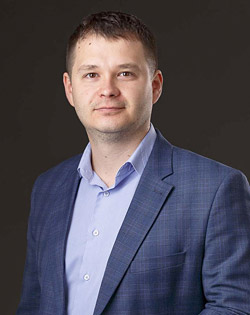 Vladislav Andreevich, how long have you been working in DLNP, what are your scientific interests?
- I have been working since July 2018. In general, my work focuses on meeting applied problems of medical and scientific imaging: it is important for me not only to get an image, but to extract physically correct information from the data and to restore the parameters of the object so that they can be trusted.
If we talk about my scientific interests, they include the research and development of tomographic techniques, as well as detector technologies. First of all, this is multi-energy computed tomography (MECT): when, according to spectral data, it is necessary to restore the composition of the substance and to correctly separate the materials. At the same time, the emphasis is on Timepix/Medipix photon-counting detectors since it is in working with them that the issue of accuracy is often met: by which technique it is more reliable to estimate the focus, how best to distribute components similar in properties, how to reduce systematic errors. Another important area is preclinical imaging. I am engaged in the development and research of micro-SPECT systems (SPECT - single-photon emission computed tomography) based on Timepix family detectors with CdTe sensors.
There are also related topics that naturally "grow" to the main tasks. With colleagues from the Faculty of Chemistry and the Faculty of Fundamental Medicine of Moscow State University, we develop and investigate lanthanide-based contrast agents for MECT. We are engaged in the analysis of the elemental composition of objects, including non-trivial samples - archaeological and paleontological finds, cores, everything whose composition and structure is more important than the external picture.
Please, tell us about your project that has been awarded a grant.
- I have been doing this project since 2019. Then, it did not look like a separate "grant project" but rather as a task that really hooked me, since it simultaneously has an understandable applied goal and serious physics and engineering and the mathematics of reconstruction. And it also has a very clear answer to the question "why": this is about preclinical nuclear imaging working well in laboratory animals (small rodents) and not just in humans and large objects.
The idea occurred mainly during discussions with my supervisor Alexey Zhemchugov and I like it precisely for its logic. Nuclear techniques, such as SPECT, PET (positron emission tomography), CT (computed tomography) have been used in medicine for decades and these are well-working tools in oncology, cardiology and neurology. SPECT and PET show how the radiopharmaceutical accumulates in the body and CT shows the morphology of the object. And when you unite these techniques, you can no longer just "see the organ" but in fact track the pharmacokinetics and biochemistry: where the drug came, how it was distributed, what happens to it.
Afterwards, the preclinical begins. On mice and rats, you need to do the same, only the object is several times smaller, the requirements for detail are completely different. High-resolution PET/CT is beautiful, but expensive and infrastructurally difficult: cyclotron, drug production - all this cannot be provided everywhere. In this sense, SPECT as an addition to CT looks like a much more "earthly" solution. The problem is that the classic SPECT or gamma chamber has a spatial resolution of about a centimeter and for small rodents this is comparable to their size. For the technique to be useful in the preclinical, it is necessary to go to the millimeter scale.
Then, in fact, our plot comes. The idea came from Cuba: colleagues from CEADEN (Centre for Application and Development of Nuclear Technologies) and related organizations that work with radioisotopes and preclinics honestly formulated the need - they develop drugs, yet they cannot see well in which organs of the mouse these drugs accumulate. And at that moment, we had detectors which we worked with and there was a feeling that they could find a new interesting application. This is how the motivation developed: there is a specific medical task and there is a technological base that potentially allows one to take a step towards meeting it.
Logistically, the essence of the project is to develop a micro-SPECT system based on direct conversion of gamma quanta in a CdTe sensor and pixel registration on a Timepix chip and the key component of collimation is not a classic thick collimator with holes, but a coding aperture. In a classic gamma-chamber, you rigidly cut the directions of the photons that need to be registered and because of it, you lose sensitivity and still run into a resolution limit. And in the encoding aperture, the idea is different: you pass more particles, but "encode" the information in the shadow structure on the detector and then mathematically unravel the image. And here we were very helped by the experience that Doctor of Physics and Mathematics, Head of Department of the Kurchatov Institute Research Centre Oleg Ivanov brought to Dubna when he talked about gamma visors and the principles of coding apertures.
As a result, we came to an architecture that, it seems to me, is already internally consistent: the Timepix detector, the encoding aperture and reconstruction algorithms that were initially "sharpened" for this geometry and for the real response of the system. And most importantly, this is not a dead-end design "made one prototype and that's it". This scheme is conceptually mature in the sense that it can be developed in future without breaking the basic ideology. It, by the way, is one of the differences from many scintillation micro-SPECT systems: improvements in them are often local and quite quickly run into the physical limitations of the scintillator and photodetector. Here, the ceiling is noticeably higher precisely because the entire system is based on direct registration and a digital response prototype.
What problems does this project meet?
- First and foremost is the achievement of high spatial resolution in SPECT for laboratory animals with acceptable sensitivity. That is, it is not "theoretically possible" but so that it is possible to do practical preclinical investigations or close to preclinical ones: pharmacokinetics, drug comparison, low-level investigations - and to get a picture of a scale where it makes sense. The second story concerns quantification and reproducibility: when you have pixel registration and it is possible to work with spectral information, there is a chance to better suppress the scattering contribution, more precisely, to take into account the effects in the detector and collimation that ultimately allows you to get a more honest reconstruction and not just "beautiful".
I will separately mention an important point - development potential. The most obvious and technologically justified step is the transition from the first generation Timepix to Timepix3 and in the future - to Timepix4. In them, the reading mode fundamentally changes: instead of the frame mode, the system passes to event registration, when each registered photon immediately goes into the data flux as a separate registering. Due to it, dead time practically disappears and you do not have to constantly choose between long exposure and event overlay (pile-up), when several photons come almost simultaneously and begin to distort the spectrum. This is especially important for coding apertures and other multi-sync circuits, where high streams can hit the detector. In addition, temporary information on each event is improved: we more accurately estimate the moment of photon registration and this is no longer a formal property. It gives a chance to carry out investigations with time synchronization by respiration and cardiac cycle, that is, to accumulate data only in the "correct" phases of movement and thereby, to reduce lubrication and to increase the stability of reconstruction, especially, when the "shadows" from different sections of the collimator partially overlap.
There are also clear and realistic increase areas for the CdTe sensor. Such as, increasing the thickness of the sensor within a reasonable range significantly increases the efficiency of registering at higher energies, conventionally starting from 120-160 keV. The practical meaning is simple: we expand the set of radionuclides which the system becomes really useful with, since photons of such energies begin to be registered much better. Yes, it enhances the effect of charge distribution over neighboring pixels, when the energy of a photon is "smeared" into several pixels and worsens both spectral and spatial accuracy. But this is not a dead end: it can be compensated both at the level of electronics/thresholds and at the level of algorithms, if such events are correctly taken into account during processing.
In this sense, the "key" in general is largely to bring the system response prototype to a full level. That is, so that the reconstruction takes into account not only where exactly we expect to see the signal, but also how it changes with the energy of the photon, with the depth of interaction in the sensor, with a specific collimation component, how exactly the charge is distributed between pixels and so on, and so forth... Then we more strictly and honestly begin to describe how the system develops data. And it gives a great advantage even without a radical alteration of the iron.
Another strength of this architecture is the multi-energy mode. In scintillation systems, energy selection is usually quite rough: wide windows, limited accuracy, many compromises. And in the Timepix approach, with correct calibration and accounting for the effects of registration, it is possible to use the energy of each event much more accurately. In practice, it means more correct suppression of scattered radiation, the ability to work with several isotopes in an investigation and in general, to obtain richer physical information at the output. For preclinics, this is often critical, since small objects, low activities and the need to compare results between series of measurements are relevant there.
If we answer the question "what is the point" with a phrase, I would formulate it as follows: we make micro-SPECT on Timepix with a CdTe sensor with a coding aperture, where high resolution is achieved not by the fact that we "squeezed" the stream with a collimator, but by the fact that we cleverly encode the direction which photons are registered from and afterwards, restore the image mathematically, relying on a physically correct prototype of the system. And if we say "what problems it meets", then it is the possibility of developing a relatively inexpensive in infrastructure, but high-resolution functional visualization for investigations close to preclinical and with an understandable trajectory of development - by detector, sensor, collimation and reconstruction algorithms.
Why do you think your application has won the grant?
- I think that the project has won the grant due to the fact that it simultaneously affects the fundamental and applied aspects of tomography and the "complete cycle" is clearly visible in it: from the understandable medical need for preclinical imaging to a specific technological architecture and verifiable results. This is not an abstract idea or an attempt to "do something on a hype" but the development of an area that has been consistently pursued for several years, with an understandable history of the origin of the request, with an international partner and with clear logic, why exactly the chosen combination of Timepix with a CdTe sensor and coding aperture gives a chance to reach the desired spatial resolution. In addition, the project has a realistic development trajectory: it is clear what to improve in future and what bottlenecks to close in the first place. I think this is critical for expert estimation.
How will the grant you have won help the project to develop?
- The grant helps, firstly, to transfer work from the "keeping on enthusiasm and rare windows of time" mode to a regular design pace, when you can plan stages and close them sequentially. Secondly, it gives a resource for the fact that in instrument projects, it most often inhibits progress: for engineering an investigation and bringing to a stable, reproducible configuration. In our case, it means the opportunity to systematically engage in mechanics and layout, calibrations, phantom experiments, improving reconstruction algorithms and a full response model, as well as organizing joint work with project participants, including students and partners. And importantly, the grant allows one to move to the format of the result that can be transferred in future not only in the form of publications, but also in the form of a working methodology and software tools, used in the assembly and testing of the facility and in the future, when measuring on it.
Scientific Communications Group of DLNP
