
Electronic english version since 2022 |
The newspaper was founded in November 1957
| |
|
Number 12 (4810) |
Unique ecosystem of Baksan Neutrino Observatory
At the end of February, an article "Metagenomic analysis of the microbial community of biofilm at the border of the oxygen-containing and oxygen-free zones of a deep-sea underground salt source at the Baksan Neutrino Observatory" was published in the Microbiology Spectrum journal. The staff includes employees of the Sector of Molecular Genetics of the Cell of the Laboratory of Nuclear Problems Kirill Tarasov, Mikhail Zarubin, Alena Yakhnenko and Elena Kravchenko, as well as Albert Gangapshev from the Baksan Neutrino Observatory of the INR RAS.
The deep underground biosphere, the biomass of which is estimated at 12-20% of the global total, comparable to that of all forests or marine ecosystems, is one of the least studied ecosystems on Earth. It is inhabited mainly by microorganisms - bacteria and archaea, the vast majority of which (more than 99%) cannot be cultivated in the Laboratory, so, scientists figuratively call it "dark matter of the biological universe". Each new investigation of such ecosystems, especially, those developing at the boundary of an oxygen-free and oxygen-containing environment, makes an essential contribution to understanding the biogeochemical processes occurring in the lithosphere.
The scientists of the Sector of MGC DLNP JINR and BNO INR RAS carried out work on a unique object - a hydrothermal underground source located in the far unused part of the tunnel of the Baksan Neutrino Observatory (BNO) in the village of Neutrino, Kabardino-Balkaria. The source was produced at a depth of about 2 km at the point of contact of deep anaerobic waters saturated with volcanic gases from the peripheral magma chamber of Elbrus with atmospheric air. Metagenomic sequencing was used to study the microbial community of the source. Unlike traditional microbiological techniques that require the cultivation of microorganisms in the Laboratory (that is not possible for the vast majority of natural communities), this approach allows studying the genetic material of all organisms directly in a sample taken at the investigation site.
Using metagenomic sequencing of the biofilm found at the source, 19 metagenomic-associated genomes belonging to different groups of bacteria were obtained. From the results of the reconstruction of metabolic pathways, it was shown that the microbial community of the source of BNO shows high metabolic diversity, the key processes of which are associated with the transformation of compounds coming from the magma chamber - organisms that can use the energy of oxidation of hydrogen, methane, ammonia and ferrous iron dominate in the community. Also, in the biofilm there are both aerobic organisms and groups of bacteria that carry out anaerobic processes that indicates the occurrence of zones with and without oxygen access. Interestingly, predatory cyanobacteria feeding on other bacteria were found in the bacterial community. Comparative analysis with the metagenomes of communities from deep granite massifs (anaerobic conditions) and karst caves (aerobic conditions) has shown that the source community of the BNO is unique due to specific geochemical conditions (constant flow of reduced substrates of volcanic origin + O2 access + neutral source water pH).
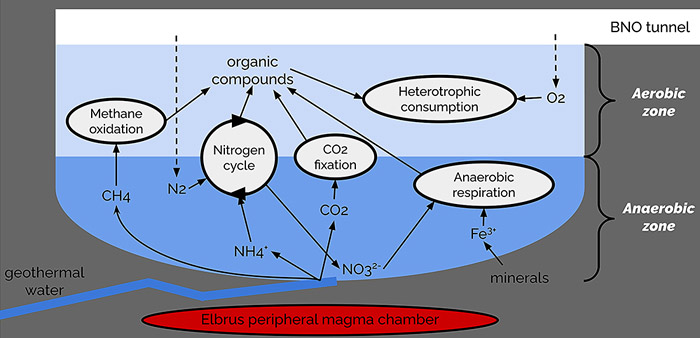
BNO source ecosystem prototype
This investigation is the first to characterize the structure and functioning of a microbial community at the boundary of a deep subterranean and incipient surface biosphere.
"The data obtained describe a new type of biological community and offer a prototype for studying microbial colonization in transitional zones where inhabitants of two different ecosystems collide," Head of the Sector of MGC of DLNP Elena Kravchenko says.
Based on the classification of metagenomic-accumulated genomes, six new genera of bacteria have been identified which candidate names have been proposed for: Candidatus Neutrinobacter, Candidatus Jinrextremum, Candidatus Inralta, Candidatus Jinrbaksania, Candidatus Neutrinellum, Candidatus Inrsubterrania. The etymology of the names reflects the location of the research (the village of Neutrino, Baksan Neutrino Observatory) and the names of the institutes that have participated in the investigation, coupled with the key characteristics of the habitat of the microbial community under study.
The investigation was carried out with the support of the Russian Science Foundation (project No. 24-24-00003).
Scientific Communications Group of DLNP
