
Electronic english version since 2022 |
The newspaper was founded in November 1957
| |
|
Number 12 (4810) |
At JINR Museum
Towards spring and anniversary of the Institute
Recently, the JINR Museum of History of Science and Technology has hosted a family holiday of Mongolia's national community dedicated to the 70th anniversary of the Institute. It was reported in detail by our weekly (No. 6 of 12 February). This tradition was widely supported by JINR staff from Bulgaria. On 1 March, they invited their colleagues from Moldova, Romania and Slovakia to the Martenitsa Spring Festival.
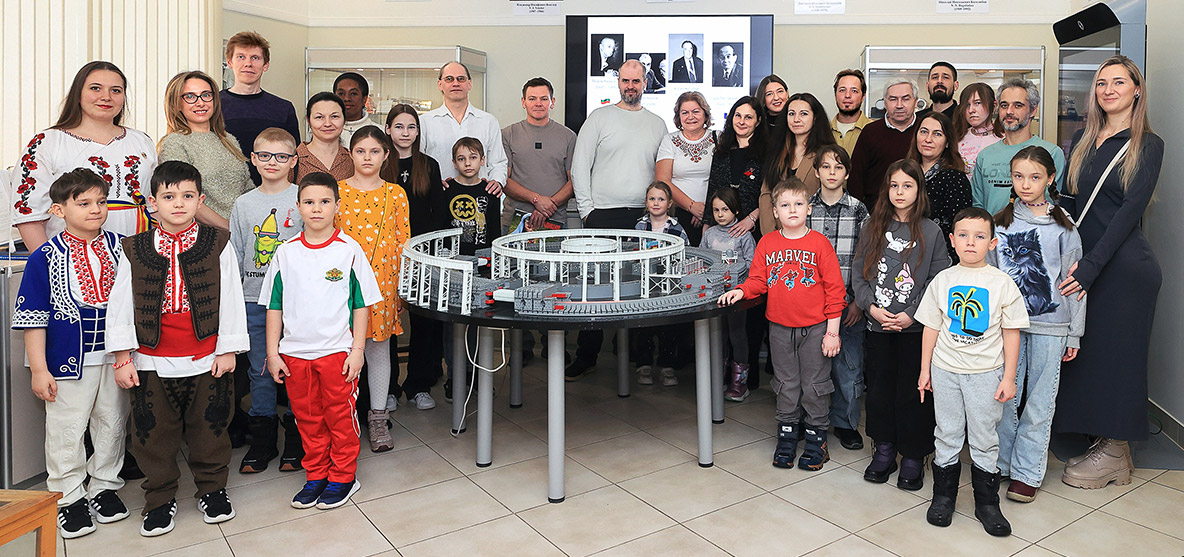
The arrival of spring is celebrated in many countries but in Bulgaria, it is recognized as a national holiday and is celebrated widely. Martenitsa is based on centuries-old traditions associated with the legends of Khan Asparuh. Martenitsa, or another name for Baba Marta, symbolizes the arrival of spring, health and longevity. On this day, in Bulgaria, it is customary to give each other amulets in the form of bracelets or female and male figures woven from white and red threads. They are usually worn until the first spring birds and the first flowering of trees. White color means masculine, purity, strength, sun. Red - feminine, blood, health and life. On this day, Bulgarians greet each other with the words: "Happy Baba Marta!" A similar tradition also exists in Romania and Moldova. There the holiday is called Martisor.
The families gathered at the JINR Museum learnt about the main milestones of the history of Dubna and our Institute, in the establishment and development of which the outstanding scientists from Bulgaria and Romania took part, including Georgy Najakov, Emil Dzhakov, Horia Hulubey, Shcherban Tsitseika, Tsvetan Vylov. Among the exhibits of the Museum, there are medals of Marin Drinov and Dmitry Kantemir that were awarded to Academicians V.G.Kadyshevsky and A.N.Sissakian...
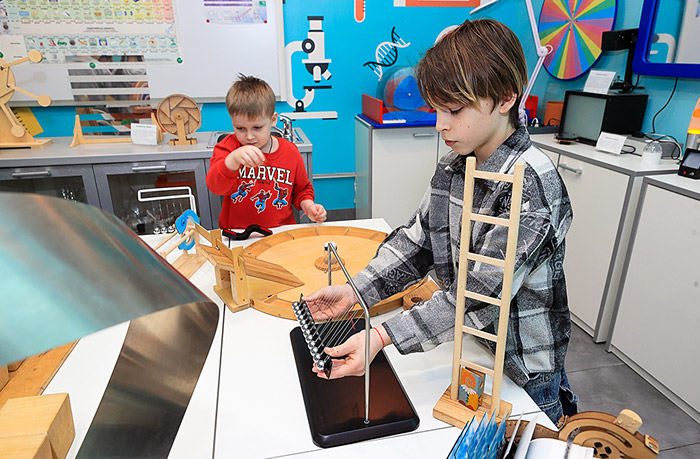
A collection of books on Bulgaria and Romania, including the lifetime edition of Professor Marin Drinov's "Settlement of the Balkan Peninsula by the Slavs" (Moscow, 1873) was exhibited in the lecture hall. Exciting physical experiments that are interesting not only for children, but also for their parents were shown in the "CLASS laboratory".
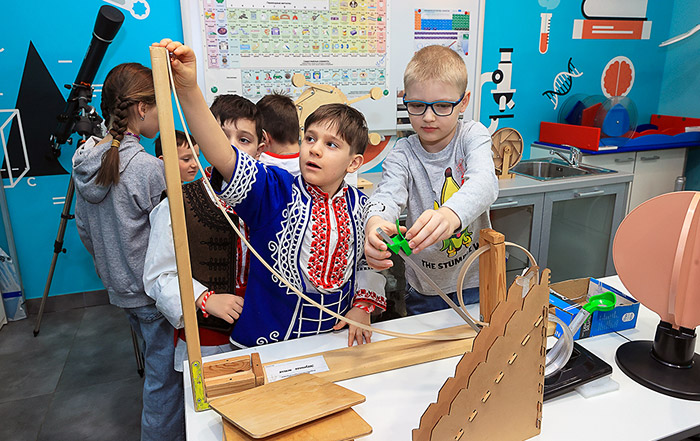
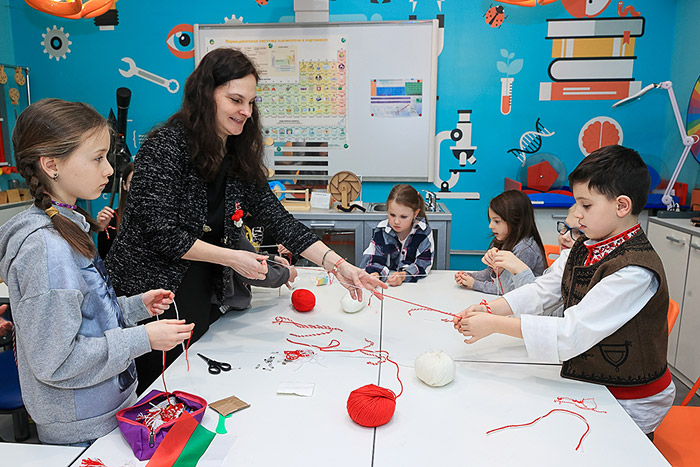
A researcher at FLNP Zdravka Slavova spoke about the Martenitsa holiday. With great interest, everyone participated in the fabrication of martenichki - bracelets and figures of a girl (Penda) and a boy (Pizho) from red and white woolen threads. The highlight of the holiday was the performance of two boys in national costumes Kian and Kayel Samuilovs that sang songs in Bulgarian very expressively and everyone sang along with them.
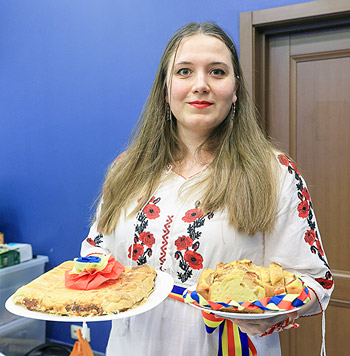 The wonderful ending of the holiday was a joint tea party, which women had baked a cheese pie called Banitsa, as well as lush big bread, cakes, cookies and even meat kebabs for.
We are very grateful to everyone that supports the initiative of such events. After all, JINR is a multinational family and it should be cherished.
A FLNP chief specialist Lyubka Kostova from Bulgaria that had taken an active part in organizing the event, shared her impressions of the celebration. Thanks to her, the idea arose of uniting several fraternities and inviting guests that are happy to share the tradition of meeting spring.
"We are very grateful to the JINR Museum of History of Science and Technology for the initiative and invitation. 1 March is a traditional spring festival for Bulgarians and we were going to organize something on our own. It was unexpected and pleasant that the Museum remembered our custom and made an event for us.
In Bulgaria, there is a belief that all months are masculine. And only March is female. The holiday of the first day is called Baba Marta. They say that when Baba Marta quarrels with her brothers, she immediately begins to get angry and then the weather is bad. But she quickly forgives everything, they are happy again and then the sun comes out.
Initially, it was expected only Bulgarians to take part in the event but I knew that Romanians and Moldovans had the same holiday and offered to unite everyone. A few more friends of our communities came. I wanted to invite more guests because there are many Russians that know this custom but the little space of the Museum did not allow it. Today, we want to figure out how to organize a big meeting next year. We hope that the Museum will help us again, especially considering that next year, it is expected to move to a new, more spacious premise.
On 3 March, the Bulgarians have another important holiday - the Day of the Liberation of Bulgaria from the Ottoman yoke. At the end of the Russo-Turkish War of 1877-1878, the Russians liberated us from the Turks and five centuries later, Bulgaria appeared again on the map of Europe. We respect this day very much and celebrate. So, our event in the Museum united these dates for us.
We have also received an invitation from the Bulgarian Embassy in Russia to celebrate national holidays in Moscow. But we replied that we would not be able to attend, since the Museum had already invited us first and we sent only a "small delegation" of five people to Moscow to represent Dubna's Bulgarian community. The main part was here.
It went well. The programme turned out to be very successful, focus was on both children and adults. The children were happy, in the Museum, they were shown interesting physical experiments. For adults, they had a good tour of the Museum with a story about the history of JINR, many discovered facts that they had not known about before, such as, the first Bulgarian scientists that had worked at the Institute.
All participated in a master class on weaving Martenitsa - a traditional amulet made of red and white threads. UNESCO has included Martenitsa in the list of cultural intangible heritage of mankind. Previously, they were made themselves but today, they are mainly bought. But this time, there was nowhere to buy and we showed how you can do it with your own hands. I baked a traditional treat - bread that is usually decorated with flowers or wattle. It was a valuable opportunity to get together, to talk and to meet in an informal setting."
A junior researcher at VBLHEP from Romania Madelina-Mihaela Miloy spoke about her participation in the festive event,
"I'm happy to talk about this event! 1 March is one of the most anticipated holidays in Romania and often girls and women return home on this day with full hands of flowers, handbags with gifts and of course, with a lot of Martisors. Martisor is a red and white thin cord that is attached to small toys, brooches, jewelry, chocolate, flowers and so on. The tradition dictates that this lanyard should be worn on the chest and often, Romanian girls and women attach it along with a small brooch. We also celebrate 8 March but it is considered our Mothers' Day. Schoolchildren can arrange a performance in honor of their mothers, grandmothers and teachers. I remember how in childhood I had to prepare poems, songs, dances, theatrical performances for such a holiday, as well as to make many gifts.
I was very happy when I was offered to spend 1 March at the JINR Museum of Science and Technology. I made two pies that are associated with my childhood (there are a lot of pastries in our kitchen). One with cottage cheese (what we call "tvorog" in Russian) that I baked according to the original recipe, the other- with apples, the recipe of which I changed a little - made without sugar. Despite the fact that the event was small and rather prepared for children, nevertheless, there were moments that were interesting for adults. It was interesting to see that the "neighbors" have similar traditions and in some aspects, identical to Romanian. And it was very nice to get together, introducing our friends that do not live in the Balkans to our culture.
I hope that next year, we will be able to make this event larger and to invite all our colleagues from the Institute! We will be able to prepare delicious food, interesting songs and master classes. And also dances in which everyone can participate. It could be such a great event! And since last year, there have been two days of Belarusian cuisine in the VBLHEP dining room, why not to arrange several days dedicated to Martisor and Martenitsa in March?! The dishes in our region are also very interesting and tasty and I will be happy to cook them in a professional kitchen. Cooking is actually one of my hobbies. I really hope that all this can be realized."
The meeting of spring at the JINR Museum was also commented on by FLNP Deputy Director Norbert Kucerka from Slovakia:
"I gladly took part in the Martenitsa holiday. It was very interesting and informative for me. The staff of the Bulgarian National Group presented their traditions to us and both adults and children liked everything. Separately, I would like to emphasize the considerate approach of the Museum staff to children that were presented with the world of physics in a playful way. Uniting the history, traditions and modernity of the Institute as a scientific centre and a centre of folk cultures is worth continuing and supporting."
Nadezhda KAVALEROVA,
Maria KARPOVA,
Photos by Igor LAPENKO
