
Electronic english version since 2022 |
The newspaper was founded in November 1957
| |
|
Number 12 (4810) |
Their names - in the history of the Institute
We dreamed of super tasks
On 12 March, a FLNP seminar in memory of D.A.Korneev was held. Reports were delivered by the senior researchers of the Laboratory A.M.Balagurov - "D.A.Korneev at FLNP JINR" and V.L.Aksenov - "D.A.Korneev - the founder of neutron reflectometry at FLNP".
"This seminar continues the series of scientific seminars dedicated to the activities of the founders of neutron physics research in our laboratory," FLNP Director Egor Lychagin opened the event. "On 8 March, Dmitry Anatolievich would have turned 80 years old. Two years ago, V.L.Aksenov held a FLNP seminar on the development of reflectometry of polarized neutrons at FLNP, a part of his speech was dedicated to the scientific activities of D.A.Korneev."
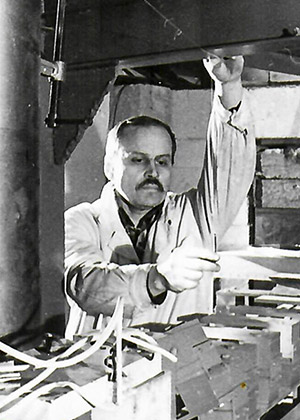 |
| D.A.Korneev. Photo by Yury Tumanov |
The speaker cited significant articles by D.A.Korneev, very diverse in topic, purely methodological and scientific, including those published in such a prestigious journal as Physics Letters B. In total, 67 publications by him and his co-authors had been published, three of them posthumously. Anatoly Mikhailovich cited 11 scientific and methodological topics which Dmitry Anatolievich had worked on. According to him, each of them would be sufficient for the preparation of a Ph.D. thesis and all together - for a doctoral thesis. But there was no time for a thesis. "His reputation was determined not by the Hirsch index, not by rank but by scientific authority that quickly increased to a high level and was as such until the end of his life," A.M.Balagurov highlighted.
With an epigraph to his speech, Victor Aksenov took a quote from the diary of D.A.Korneev, "We do not want to receive nonsense tasks... We dream of super tasks so that if we can meet them, we can be proud of it all our lives." He marked the beginning of the path of D.A.Korneev the Branch of the Research Institute of Nuclear Physics of Moscow State University - "we have all graduated it" and the addresses - 10 Leningradskaya - the JINR hostel, 12 Leningradskaya - the Branch, 14 Leningradskaya - the hostel of Moscow State University, these all are known to many employees of the Institute. There was a strong international friendship, not limited beyond laboratories. "Dmitry Anatolievich was very sociable, artistic, it was easy to communicate with him," Victor Lasarevich recalled. "He had quite close relations with Yu.M.Ostanevich. Much of what had been done by D.A.Korneev, they discussed together." In the last years of his life, Dmitry Anatolievich returned to mirror neutron guides, which his scientific biography at FLNP began from and tried to restore this activity. In PNPI, he had been, as V.L.Aksenov said, his man, for the past ten years he had still been well remembered there. The first SPN-1 reflectometer was conceived back in the mid-1970s and IBR-2 was ready to launch in 1984. The first experiments on reflectometry at IBR-2 were carried out in 1988. At the same time, technologies for spraying thin films developed and Dmitry Anatolievich was immersed in this topic. Later, he and his colleagues developed the reflectometer of polarized neutrons REFLEX, the spectrometer SPN-2, the next generation of SPN - the REMUR reflectometer came into operation after the death of D.A.Korneev.
Victor Lasarevich told what had been done on the REMUR reflectometer, including in the task of resonance amplification of the polarized wave function. The complex developed on beamline 8 of the reactor (REFLEX, REMUR and the new GRAVES reflectometer) allows developing this area in future. The speaker dwelled on the future problems of reflectometry at the new NEPTUNE reactor. In the fundamental issues of neutron optics that should be investigated on these new devices, V.L.Aksenov highlighted two investigations by D.A.Korneev and V.K.Ignatovich that are of great importance. Dmitry Anatolievich was the first to focus on these issues and his role was leading and Vladimir Kazimirovich made a theoretical justification for these investigations.
D.A.Korneev was characterized by a constant desire to look for extremely complex problems of a fundamental nature. V.L.Aksenov concluded his speech with a quote from D.I.Blokhintsev, "Among scientists, there is a special category of people obsessed with a passion for science... It is on these fragile, few people that all the success of this or that institute depends. These people are usually impractical, sensitive and vulnerable, they need to be protected, they need to be guarded, they are white cranes."
Giving explanations to the young laboratory staff, V.L.Aksenov said that the issue of preparing a thesis arose more than once but Dmitry Anatolievich was not going to write. He was full of ideas, yet he did not have time to implement all of them. He was, without a doubt, a doctor of science of the highest level.
The widow of D.A.Korneev Nadezhda Kavalerova thanked the Laboratory for holding the memorial seminar. "Memory is the main thing," she said. "Thanks to Yu.A.Tumanov, there are many photographs of Dima. He loved to shoot "iron" and people with burning eyes, so he often photographed Dmitry Anatolievich." Nadezhda Sergeevna showed the diploma awarded by D.A.Korneev "For a great contribution to the training of young specialists at JINR" signed by D.I.Blokhintsev, spoke about his social work. And about the "covens" in Siberia on vacation, during which he tried to earn money for an apartment for the family. We learned that from the first to the tenth grade, Dima played in the school theater and also, hosted a children's programme on Gorky television.
There was a moment when, impressed by the film he had watched, he wanted to leave the physics department and to go to study as a director. He was in such a bifurcation all his life, sometimes participating in the design of laboratory skits.
He accompanied the first polarized curves obtained in 1994 at REFLEX with a dedication to his wife. Agree, not every physicist does it.
Olga TARANTINA
