
Electronic english version since 2022 |
The newspaper was founded in November 1957
| |
|
Number 43 (4791) |
Sport
Climbing wall - a space
for dialogue and exchange of experiences
On 25 - 26 October, the Dubna Climbing Gym, with the support of the Joint Institute for Nuclear Research, hosted the second Dubna Boulder Fest within its building. We spoke to the competition organizer and one of the Gym's founders Dmitry Dementiev about the Festival, its participants and its future prospects.
How is the Festival organized?
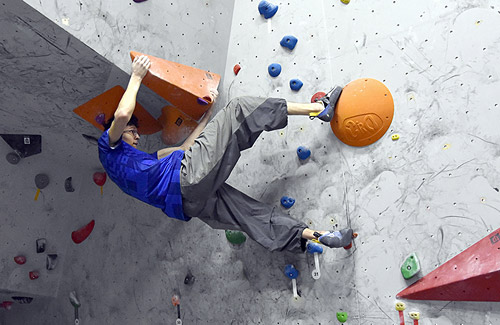
- Our Dubna Climbing Gym was registered as an autonomous non-profit organization in 2023, when, with support from JINR, a new climbing wall was built, where we practice and even host competitions. This is the second sports festival being held here. This year, 87 people registered to participate, almost double the number registered last year. The Festival is held in a bouldering format. This type of climbing involves climbing a short route without ropes and consists of complex moves.
The gym is small and to allow more athletes to participate, we've divided the competition into timed sets of 2.5 hours. Each set has about 18 participants. A total of six sets are scheduled over two days.

When organizing the Festival, we aimed at ensuring that not only our gym members and JINR staff, but also guests from other cities could participate. We wanted to showcase our climbing wall to a variety of athletes, creating a space for dialogue and exchange of experiences. It's especially valuable for us to meet and see the skill level of other participants, as we still have no professional coach and rely primarily on each other.
To generate general interest and to create good routes, we have invited the well-known climbers from Moscow Pavel Isaev and Dmitry Glebov.
They prepared 38 routes of varying difficulty levels. This is a creative endeavor. Routes are designed with an emphasis on movement patterns, technique, balance and coordination. The climber's job is to ensure the routes are varied, allowing us to objectively evaluate the strongest athlete. When designing routes, the specific features of the gym also need to be taken into account.
This time, our climbing wall attracted truly strong participants - real athletes.
How are competitions evaluated?
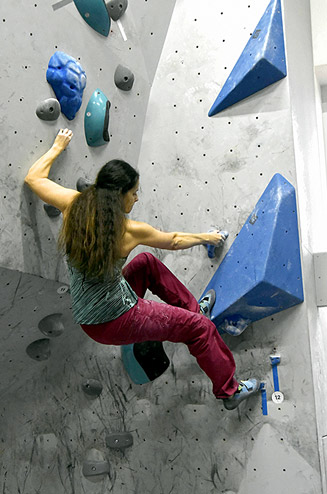
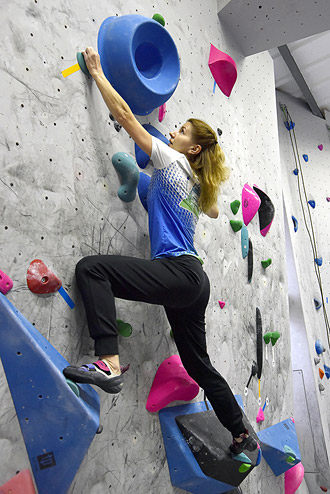
- Our event is held in a festival format, not as a traditional competition. We offer athletes several routes to choose from. Scoring is done in stages. Participants make their own marks on their individual scorecards as they complete each route. There are also judges in the hall that primarily look for the expected winners. Firstly, they can be identified by their movements and secondly, the community often already knows what to expect from each participant. The main focus is on the difficult routes; it's impossible and pointless to control all 38 of them. Each route, depending on its category, is worth a certain number of points if completed. However, there is a difference in points whether you complete the route on your first try. Only the points for the 10 most difficult routes completed by a participant will be taken into account. The winner is the one with the most points.
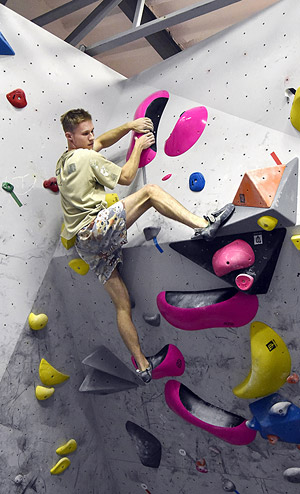 Men's and women's categories are judged. We also award these same categories to JINR staff.
Of course, we want to evaluate the strongest competitor, but our main goal is to make a name for ourselves, showcase our climbing wall, watch top athletes compete and gain new experience. And of course, to have fun.
What are your plans for the development of the Festival and the gym?
- We're considering the future format. We have limitations but we want new strong athletes on a regular basis. On the one hand, the main audience for climbing walls are people that come to rock climbing for fitness. And it's truly a good form of fitness, developing coordination and brain connectivity. It engages all muscle groups. But on the other hand, rock climbing is currently an Olympic sport that makes it very promising. Athletes choose this sport, want to develop in it and we want to provide that opportunity. We currently have a children's section at the climbing wall. We also aim to organize summer climbing trips. We want to see new Dubna athletes and that there will be no need to travel to Moscow for training.
How popular is real rock climbing?
- Trends in modern rock climbing increasingly separate indoor and outdoor climbing. Climbing styles change because it's a professional sport. Competitions are held indoors to create equal conditions for all participants and to allow for the most objective evaluation. But the origins of rock climbing, of course, were developed outdoors. And the two disciplines are closely related. Members of the Dubna Gym go on trips in small groups. There have been trips to Karelia, Crimea and the Caucasus. We've competed in the "Rocks of Russia" competition. We hope to organize a large gym trip, including with children.
How many years have you been in this sport?
- I started rock climbing 17 years ago but I wouldn't call myself an athlete. My parents had been involved in mountaineering since their university years and my mother was also a rock climber. When I entered the Physics Department at Moscow State University, I joined the University's Alpine Club. It was there that I first began hiking and rock climbing. It's worth stating that mountaineering and rock climbing are different sports. Alpine climbing involves climbing mountains but in addition to rock climbing, it also includes ice climbing and snow climbing, taking into account the terrain. Rock climbing is a sport that focuses specifically on rock climbing. I'm very pleased that students from the MSU Alpine Club came to our Festival this time. Students from the Physics and Mathematics Departments of Moscow Institute of Physics and Technology and the Higher School of Economics also attended. So, the tradition of uniting science and rock climbing goes on.
Feedback from the Festival participants
Nastya Kurmacheva, 23
"I've been climbing for 13 years, six of which I've been coaching. I have heard about the Festival from one of my students and started passing the information along until we got together as a team of six for the trip. I really enjoyed participating in these competitions. I have never expected it to be so great! Winning, of course, wasn't the goal; the main thing was enjoying participating and there was just so much of that here! I felt nostalgic, since there was a similar gym when I was a kid. It was so joyful to be here with my friends. Climbing was pure pleasure because the routes here have an amazing style, good holds. I have heard that Pasha Isaev from Moscow was a big fan of the tricks. His style united components of modern and old-school climbing. I haven't seen anything like that in a long time. And it's just fantastic. I wanted to climb more after the set, but my skin was already worn out and fatigue had taken its toll. I couldn't climb a 7B route during the set but I did it afterward. It won't count but it's nice to know. I'm 100 percent satisfied."
Vadim Medvedev, 32
"It was a great festival, with challenging and interesting routes. I'm a programmer and have been rock climbing for about three years, both indoors and outdoors. It's the only sport I practice. I have learned about the Festival in Dubna from my coach that also participates and is a strong athlete. My goal was to climb as many challenging routes as possible. And I think I accomplished what I had set out to do, meeting my expectations. I'd be happy to come back."
Anna Abashina, 29
"I have learned about the Festival in Dubna by chance in a chat. I'm a children's rock climbing coach by profession. I train mostly indoors, as well as outdoors when I can. I love festivals and competitions. It's nice to win but in general, I come for the new routes, new moves and the challenge. You learn something every time. I was surprised when I saw such a large gym in Dubna. I thought it would be small in a small town, as it had happened before in my life. But my expectations weren't met; in reality, it's a large and awesome climbing wall. I loved the routes. Personally, I really love jumping and I personally found routes that allow for it a plus."
Maxim Orlovsky, 26
"I have learned about the Dubna Festival in a general climbing chat and decided to go, especially, since it's nearby. I liked the competition system here. Usually, they prepare several dozen routes and count how many you climb. Here, to qualify, you only had to climb 10 difficult routes and I liked that much more. I was able to warm up on the easier ones and focus on my top category. The routes here are very good, with overhangs and jumps - the right amount of everything. There's no one dominant feature. Of course, if you're going to a competition, you need to aim for the first place. I managed to climb one 7B. So, generally, I'm happy with my performance. I've been climbing for almost two years. I came to this sport from wrestling, where I used to do a lot of pull-ups and for me, the key moment was that I could now do them on holds. Once I realized it, climbing completely consumed me."
Ekaterina Loshchilina, 48
"I came with my family: me, my two sisters and my brother. We have noticed that this year's festival was more serious. Last year, there were easier routes and a beginner's competition that we even won. This time, I saw a lot of Moscow citizens and real athletes coming that raised the level of the competition. For us, as amateurs, such competition left no chance. Even though I've been climbing for 20 years, this is still a whole other level. I love this sport and practice on real rock whenever I have the opportunity."
Alexey Ovchenkov, 21
"I study at MIPT and someone has posted about this festival in our group chat. Rock climbing is my hobby. I practice both indoors and outdoors when I can. Getting out into nature is a great atmosphere. Four of us came to Dubna with my friends that study at the Higher School of Economics. They're athletes and I think, they'll definitely win some prizes. I just came to have fun and I did. It's very cozy here at the climbing wall; you walk in and feel right at home. And it's great that there's a warm-up area; not all climbing areas have one and that's important. I also liked the routes here."
Winners:
Overall
Women: 1st place - Victoria Volodina; 2nd place - Anna Abashina; 3rd place - Anna Ivanova; 4th place - Anastasia Kurmacheva; 5th place - Ksenia Samoylova.
Men: 1st place - Vadim Nazin; 2nd place - Maxim Peskin; 3rd place - Vitaly Levchenko; 4th place - Nikolay Korochkov; 5th place - Valery Vorobev.
JINR Staff
Women: 1st place - Polina Filonchik; 2nd place - Alena Kolbina; 3rd place - Alina Vishneva.
Men: 1st place - Danil Shelkovkin; 2nd place - Dmitry Dementiev; 3rd place - Leonid Grigorenko.
Maria KARPOVA,
photo by Evgeny KORENSKOV