
Electronic english version since 2022 |
The newspaper was founded in November 1957
| |
|
Number 43 (4791) |
JINR - China: cooperation results and future plans
On 24 October, the third meeting of the Joint Coordination Committee (JCC) between JINR and the Ministry of Science and Technology of the People's Republic of China (MSTC) was held at the Joint Institute for Nuclear Research. The Committee functions in accordance with the Protocol on Strengthening Cooperation in Fundamental Scientific Research between the Ministry of Science and Higher Education of the Russian Federation, the Chinese Academy of Sciences, the MSTC and JINR.
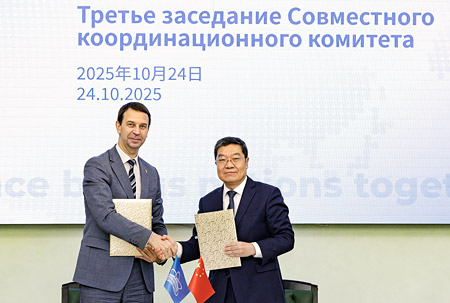
At the opening of the meeting, Co-Chair of the Committee and JINR Director Grigory Trubnikov emphasized that the implementation of the Protocol has already reached the practical level and covers a wide range of areas. He highlighted the particular importance of JINR's megascience project, the NICA accelerator complex.
"NICA is one of the flagships of our collaboration. Chinese scientists make a significant contribution to the development of superconducting magnetic technologies and advanced particle detectors for the complex," JINR Director emphasized. He also expressed gratitude to the Chinese government for its comprehensive support of scientific collaboration and highlighted the interest in the participation of his Chinese colleagues in the international BaikalGVD deep-water neutrino telescope project.
In his welcoming address to the meeting participants, Vice Minister of Science and Technology of the People's Republic of China and Co-Chair of the Committee Chen Jiachang emphasized that since the establishment of the JCC in 2023, a sustainable cooperation mechanism has been established and priority areas of collaboration have been identified. He stated that this meeting aims at strengthening partnerships in fundamental research and supporting new strategic projects that will yield significant practical results.
On behalf of the Ministry of Science and Higher Education of the Russian Federation, Director of the International Cooperation Department Ksenia Trinchenko welcomed the meeting participants. She highlighted the importance of the quadrilateral format of cooperation and the role of JINR as an international platform for scientific exchange between countries.
Co-Chair of the Expert Working Group (EWG) and JINR Scientific Leader Victor Matveev reported on the results of the third EWG meeting, held on 17 October. The meeting was attended by 44 specialists - 21 representatives from China and 23 JINR staff members.
The working group reviewed the interim results of eight ongoing joint projects and deemed their implementation successful. All projects progress according to schedule, demonstrating high scientific potential and practical significance. Following the discussion, the EWG recommended continued funding for these projects.
In addition, 23 new proposals for joint research were reviewed. Following the expert selection process, the Committee approved seven new projects that will begin in 2026. Co-Director of the EWG and a researcher at the Institute of High Energy Physics of the Chinese Academy of Sciences (IHEP) and a member of the Chinese Academy of Sciences Chen Hesheng emphasized that interest in collaborative programmes increases, the number of applications has increased by 28% compared to 2024.
During the JCC meeting, the Committee representatives approved changes to the composition of the Expert Working Group. It includes CAS Academician Zou Bingsong, VBLHEP Acting Director Andrey Butenko and DLNP Deputy Director Alexey Guskov.
JINR Deputy Chief Scientific Secretary Alexey Zhemchugov highlighted the steady increase of scientific and technological cooperation with Chinese organizations. More than ten Chinese universities and centres participate in the preparation of experiments at the NICA complex. Chinese researchers are also interested in the Baikal Neutrino Telescope and other joint projects to develop accelerator and neutron technologies.
He emphasized that China actively develops its own research infrastructure, including megascience facilities such as BESIII, JUNO, HIAF, LHAASO and CSNS, as well as prepares to implement new major initiatives such as CEPC, STCF and EicC. Scientists from the Joint Institute, in turn, express their readiness to participate in these projects.
The meeting participants focused on the development of a direct high-speed communication channel between JINR and scientific centres in China. The Committee emphasized that the efficient exchange of exabyte-scale data requires a bandwidth of at least 100 Gbps. Such infrastructure will ensure stable cooperation between computing centres participating in international experiments and will be an essential component for the further expansion of cooperation.
Following the meeting, the Committee made a number of decisions:
- confirmed the successful completion of the first eight joint projects and approved their prolongation;
- agreed to support a second phase of seven new projects for a period of three years with the possibility of extension;
- approved the updated membership of the Expert Working Group;
- highlighted the significance of developing a dedicated communication channel between JINR and scientific centres in China;
- agreed to hold the fourth meeting of the Committee in 2026 in China.
The summary protocol of the meeting was signed by the Committee Co-Chairs Grigory Trubnikov and Chen Jiachang.
"Today, we see the results of real progress. Our cooperation portfolio includes eight successfully implemented projects and new initiatives that strengthen the scientific cohesion of our countries. In the future, we may jointly establish a new international scientific innovation centre, a symbol of unity in understanding the fundamental properties of matter," JINR Director highlighted, summing up the meeting.
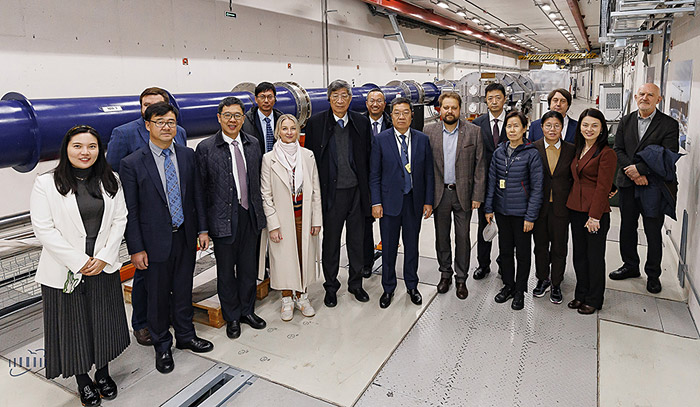
Following the meeting, the Chinese delegation toured the Institute's laboratories. The guests visited the NICA Accelerator Complex and the Academician Wang Ganchang Alley at VBLHEP, the Superheavy Element Factory at FLNR and the Bogolyubov Memorial Office at BLTP.
JINR Press Office