
Electronic english version since 2022 |
The newspaper was founded in November 1957
| |
|
Number 43 (4791) |
Their names are in the history of the Institute
Enthusiastic and honest about life and science
On 24 October, a historical and memorial seminar was held at the JINR Museum of History of Science and Technology, at which the museum staff presented a new book - a book of memoirs by Vladislav Shchegolev "Into the past through thoughts".
Vladislav. A. Shchegolev (15 February, 1934 - 29 June, 2015) was born in Leningrad. After having graduated from high school, he entered the Physics and Mechanics Department of the Polytechnic Institute. He completed his diploma thesis at the Institute of Atomic Energy, in a staff headed by I.V.Kurchatov. Since 1957, Vladislav Shchegolev had worked at the Laboratory of Nuclear Reactions. He co-authored the discovery of elements 102 and 103, participated in the synthesis of 105, made a significant contribution to the investigation of the extra excitation of compound nuclei and defended his PhD thesis. In the 1970s, Vladislav Shchegolev, on behalf of Academician G.N.Flerov, began working on the applied applications of accelerated heavy ion beams and the development of a technology for the production of track membranes. In 1989, Vladislav Shchegolev and his creative team were awarded the Prize of USSR Council of Ministers for these investigations. Vladislav Shchegolev was the author of over 100 published scientific papers, 10 inventions and two discoveries. He gave high priority to popularizing scientific achievements. His articles were more than once recognized with awards from the journals "Priroda", "Nauka i Zhizn" and others. He was interested in poetry, theater and history, as well as possessed an undeniable literary talent.

At the seminar, the JINR Museum's leading methodologist Alexander Rastorguev spoke about the book's development: "Several years ago, Oleg Ivanov, a FLNR employee, approached me and handed me a disc containing Vladislav Aleksandrovich's memoirs, essays and articles that he had prepared for his 75th birthday as an interim creative report. A few years later, when it became clear that the museum could produce not only booklets but also books, I thought it would be great to publish such a book. Surely, I started with the memoirs first. Although the disc contains interesting popular science essays, they were published in various magazines: "Beyond the edge of the Periodic Table", "Terra Incognito", an essay about Flerov "Physics should be felt with the belly" (also titled "With him, we only dream of peace"), an essay for Yu.Ts.Oganessian's 75th birthday... I compiled them, afterwards, met with V.A.Shchegolev's son Dmitry Vladislavovich. He provided photographs, not only of his first family photos, but also of his trip to Mongolia."
Dmitry Vladislavovich spoke at the seminar about his father's biography: he had received a thorough education in the humanities and had graduated from high school with a gold medal. In the family, irregular working hours were commonplace. They often began with a call from Flerov at 4:00 a.m. Vladislav Alexandrovich would go out into the hallway and talk for an hour with Georgy Nikolaevich. V.A.Shchegolev read a great deal, corresponded, discussed social and political issues and was deeply affected by the events of the 1990s.
 |
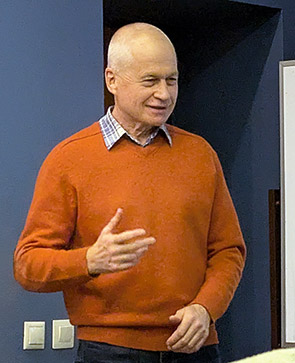 |
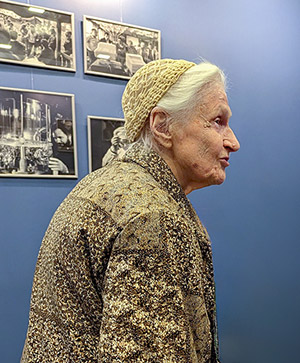
| Natalia Shchegoleva | Dmitry Shchegolev |
His wife Natalya Alekseevna spoke about Vladislav Alexandrovich's involvement with the Taganka Theater, his acquaintance with director Lyubimov and Vysotsky's house concerts. Other guests also spoke, sharing memories of those times and their impressions of the book.
An unusual film also helped to recreate the image and mores of the "golden age of nuclear physics". The museum staff learned about it while transcribing an audio recording of V.A.Shchegolev's memoirs. They asked friends, but no one had heard of it. Fortunately, the year, director and title were listed: 1966, Igor Kolovsky, "Physicists". A lengthy search led them to the Irkutsk Film Archive, but they demanded a hefty sum for its purchase. Dmitry Vladislavovich came to the rescue - he purchased the film with his own funds and today, the JINR Museum can display this unique film that captures the workings of synthesizing new elements at JINR - a romantic image of the physicists of the 1960s.
According to the participants, the seminar truly captured the spirit of that time. Scientists had worked selflessly, despite difficulties, unaware of fatigue. For families, these years had been fleeting and today, perhaps, it's time to remember and rethink the events, sensations and feelings.
Galina MYALKOVSKAYA