
Electronic english version since 2022 |
The newspaper was founded in November 1957
| |
|
Number 6 (4804) |
To the Day of Russian Science
Lomonosov was lucky and unlucky with descendants
On the eve of the Day of Russian Science, it has become a tradition at the JINR Museum of History of Science and Technology to invite Doctor of Chemical Sciences, a senior researcher at the St. Petersburg branch of the S.I.Vavilov Institute for the History of Science and Technology Igor S.Dmitriev to Dubna. Last year, he excitedly spoke about Dmitry Mendeleev (see No.5 of the weekly for 2025) and on 6 February, he delivered a lecture "The fate of Mikhail Vasilievich Lomonosov".
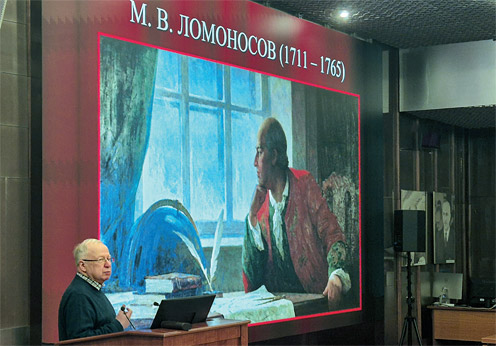
"There are as many legends about him as about anyone else," Igor Sergeevich began his speech. "In Soviet times, the biographies of Lomonosov were written, one might say, as the lives of saints. Today, when many documents are available, two images of Lomonosov arise. I'll be talking about the second of that era."
There is very little evidence of people who knew him directly, but those that knew were enthusiastic or respectful. Pushkin understood a lot in Lomonosov and was the first in the 19th century to pay tribute to him as a poet and a naturalist. The speaker cited the words from his "Travels from Moscow to Petersburg" (1833-1834), "Lomonosov was a great man. Between Peter I and Catherine II, he alone is an original associate of enlightenment. He established the first university. It is better to say, he himself was our first university... If Lomonosov can be called the Russian Bacon, then is it in the same sense that Kheraskov was called the Russian Homer; why these nicknames? Lomonosov is the Russian Lomonosov - that's enough for him." At the same time, of the three contemporary poets - Lomonosov, Trediakovsky and Sumarokov, Alexander Sergeevich singled out Trediakovsky's poetry.
Contrary to the established opinion, Lomonosov was not the first Russian Academician, it was Trediakovsky, whose documents wandered in the offices of officials for two years and Lomonosov's papers were signed in two weeks. The newly minted professors - members of the Academy were approved by the Senate, afterwards, the emperor signed a decree, after which the Academicians were sworn in at the Church of St. Andrew the First-Called on Vasilievsky Island. Lomonosov noticed one "trifle" not noted in the emperor's decree - his new salary and immediately wrote a petition to the Senate about it, "…I was granted a professor of chemistry at the Academy and what salary I should receive is not shown in that decree." And he asks to set his annual salary of 660 rubles, "for chemical science consists not only in one theory, but also in a very difficult practice that can be harmful to health."
He had no friends in the usual sense of the word. If Mikhail Vasilievich invited someone home for a cup of tea, it was already regarded as a manifestation of friendly relations. Jacob Shtelin, one of the most influential members of the Academy, made a farewell word for the memorial service for Lomonosov but he was not given to read it. The plan of the speech has been preserved: Mikhail Vasilievich was distinguished by fortress and physical power, was full of passion for science, from the point of view of moral structure - a peasant. Shtelin later wrote a pamphlet about Lomonosov. And Princess M.N.Volkonskaya, Lomonosov's great-granddaughter, describing her ancestors in her memoirs, did not even remember him.
Mikhail Vasilievich drank a lot, could make a brawl, a fight. We heard some documented stories. Once Lomonosov broke into an academic meeting drunk, showed Christian Winsheim a cookie, called the Academicians "canals and crooks". He owed Sturm 65 rubles and when he reminded him of it, he beat him, arranging a real massacre. Lomonosov was awarded eight months of guardhouse, where he could read and write (it was on guardhouse that he wrote his best poem - the arrangement of the 43rd Psalm) and later, he was transferred to house arrest. He writes to the empress, "There is no benefit to the fatherland from sitting!" And she frees him from arrest and cancels the fine imposed on him. Having become an academician, he demanded more and more administrative power, became an adviser to the Office for Science. In 1757, he sought dismissal from the Trediakovsky Academy, which a conflict arose on the basis of spelling with. The question was fundamental - what ending should adjectives and participles have? Trediakovsky died a half-beggar and today, a square is laid out at the place of his burial.
It was Lomonosov, Igor Sergeevich noted, that became the first cultural hero of Russia, earning it not with religious zeal or military exploits, but with activities in the field of education. Science was brought to Russia by Emperor Peter and such science develops according to its own laws. In England, the speaker believes, there was a similar situation, only 200 years earlier. It was necessary to deploy the elite facing science and F.Bacon performed this function there. Without making scientific discoveries, he showed that science has an independent value, it is a collective matter. It is no coincidence that Pushkin compared Lomonosov with him. According to the speaker, Lomonosov's mission is more difficult than being a great chemist, astronomer, geographer. He simultaneously demonstrated the value of science and developed a methodology of knowledge, trying to change the attitude of the elite to science. And the attitude was dismissive at best. Lomonosov in difficult conditions created a cultural environment in which science developed. The bureaucracy annoyed him but he did not fight the authorities (Soviet myth), he used it to his advantage. We owe Mikhail Vasilievich many scientific terms that we use today without hesitation. If not for him, for a long time, the mechanics would have been called cunning. And he himself was tormented all his life that he did not do everything he could and wanted.
Igor Sergeevich spoke about Mikhail's childhood and youth, many situations when his fate could go a completely different way. The peasant ingenuity and a happy coincidence helped out. His exact date of birth is not known, the date was adopted on 19 November - the day of Archangel Michael. He did not run away from home (another myth) but left, having a passport issued for several months to get to Moscow with a fish train and return. His father was a wealthy peasant, made a fortune in transportation along the White Sea. Mikhail helped him. But he loved to read more and everything. He was the only one in the family who was literate. And goodbye to another myth - they were not serfs. After Lomonosov had not returned home, he was declared "on the run" and was on the wanted list for a long time, even after having become an academician.
I.S.Dmitriev expressed two theses. First: Lomonosov was very lucky with the descendants that prepared an incredible number of papers about him, monuments, films. Second: Lomonosov was very unlucky with his descendants, since for 100 years, they have not been able to restore the small building of his chemical laboratory - the first Russian scientific laboratory. A single foundation has remained from it but the plan of the building is known and next to it, there was the house where Mikhail Vasilievich lived. A hotel will be built in their place.
I.S.Dmitriev emphasized that Lomonosov was not lucky with the teachers and he himself did not follow the news of science, although he knew Latin perfectly. We also learnt about the essence of the first chemical experience of Mikhail Vasilievich, staged in 1756 and repeating the experience of R.Boyle in 1672. More complex than Boyle's, Lomonosov's experience and conclusions refuted Boyle's conclusions. He could have made the discovery Lavoisier had made, but did not.
Lomonosov owns the idea of the Northern Sea Route, however, not in its current form. At that time, there was a perception that the North Pole was not covered with ice and it was possible to pass freely from the islands of Svalbard and Novaya Zemlya into the Pacific Ocean, with two routes running on both sides of the North Pole. Lomonosov was persistent and the first expedition headed by V.Ya.Chichagov went to the pole but did not reach it. The second polar expedition took place after the death of Lomonosov, it was headed by Admiral P.V.Chichagov, son of V.Ya.Chichagov. They also did not achieve their goals, it was decided to classify all the documents of the expedition. And Paul I, after the death of Lomonosov, exclaimed, "A fool died, only he ruined the treasury!" Lomonosov was also at enmity with G.Miller about his "History of Siberia," in which he called Ermak a robber. Lomonosov believed that a historiographer should be a reliable person, "for that purpose he swore allegiance".
I.I.Shuvalov (not a count, but the second branch of the Shuvalov clan) was the curator and real organizer of Moscow University. It was to him that Lomonosov wrote a letter in verse about the benefits of glass. And it is his name that Moscow University should rightfully bear. The speaker thoroughly answered numerous questions of the participants that showed a sincere interest in the fate of the great Russian. And in spite of everything, Lomonosov's "The abyss has opened, full of stars; Stars are endless, bottomless."
Olga TARANTINA
Photo by Anastasia ZLOTNIKOVA
