
Electronic english version since 2022 |
The newspaper was founded in November 1957
| |
|
Number 16 (4814) |
At JINR Museum
Spring Slovakia: folk traditions, history, science
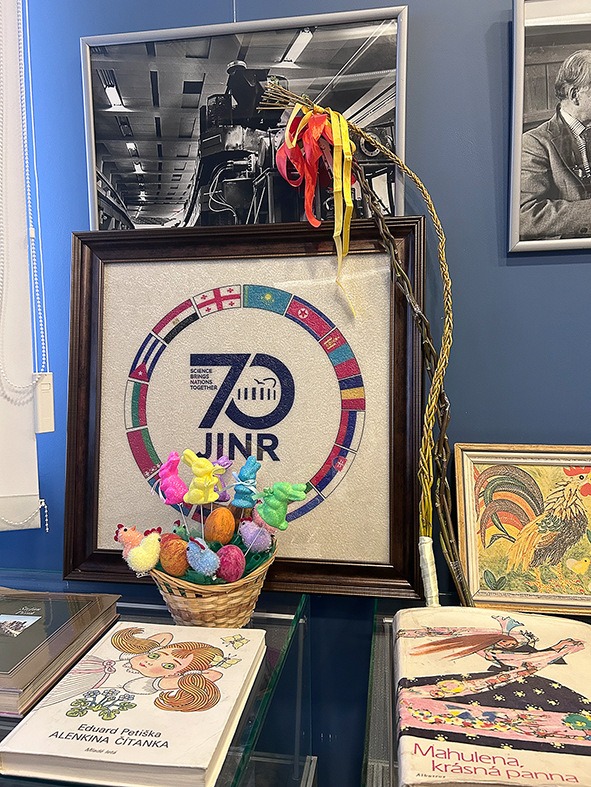
On 5 April, a meeting of the Institute's staff from Slovakia was held at the JINR Museum of History of Science and Technology. The event was timed to coincide with the 70th anniversary of JINR and the celebration of Catholic Easter. Museum staff made a proposal to hold a series of meetings for the national communities of JINR Member States. The date and topic for the meeting were chosen by the members of the community themselves.
The main organizer from the Slovak staff was FLNP Deputy Director Norbert Kucerka. He said that the proposal to hold a meeting and the upcoming Easter perfectly coincided, "It is a great success to hold such an event. I am grateful for the opportunity to remember the traditions of Slovakia and introduce them to our children and guests. There is an opportunity to tell a lot about something because our Easter holiday is unusual and nowhere but in Slovakia and the Czech Republic you will not encounter such traditions. In my early youth, I gladly participated in many folk festivals. But over the years, it's gone from my life, including the move to Dubna and my kids haven't seen anything like that.”
Easter in Slovak culture is known as Velka night (Great Night). This is the second most important holiday after Christmas. It is celebrated four days from Friday to Monday and in the country, these days are declared weekends. The Great Night is a mixture of the traditions of Catholicism and the pagan meeting of spring. This is the main difference from the traditional Easter, an exclusively religious holiday. The symbols of the Great Night are associated with the birth of a new life, so, these days, bunny figures, lambs, chickens, eggs and flowering plants are used to decorate the house and gifts.
On the part of the community, master classes, a presentation on the holiday, a report on cooperation between Slovakia and JINR were prepared, Slovak books and special treats were presented: traditional egg cheese, salads, Easter cake. Friends and colleagues from Russia, Egypt, Romania and Serbia were invited with their families.
 |
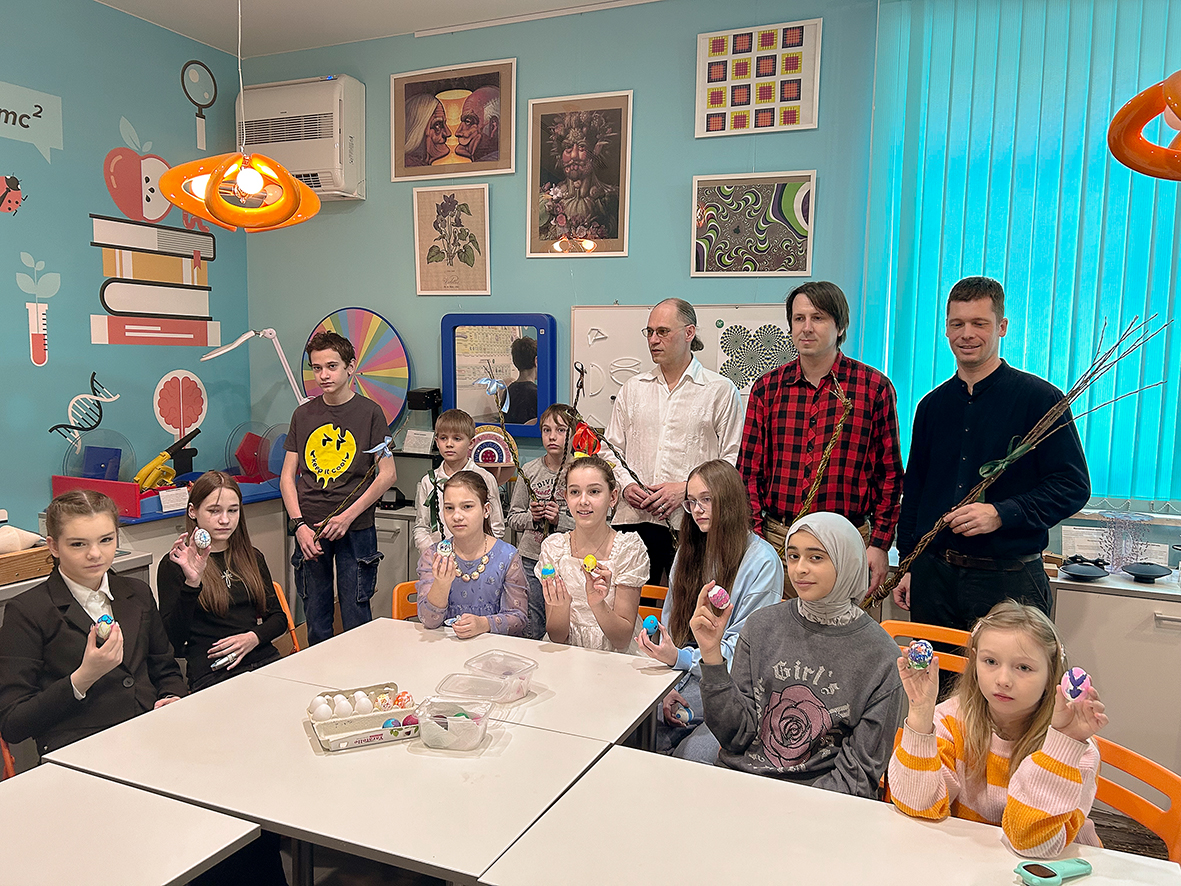
At the master classes, children participated in the creation of the classic attributes of the Great Night. The girls were decorating Easter eggs. The boys had a unique opportunity to weave a rod of eight palm branches that is called korbach. In the rituals at the meeting of spring, the girls were slightly swept with such a rod, symbolically giving them health for childbearing. In return, the girls offered a treat and hung a ribbon of a certain color on the korbach, as a message of sympathy or, conversely, refusal of attention. The festive ritual also included dousing the girls with cold running water that also meant giving well-being and scaring away troubles.
Head of Sector of BLTP Michal Hnatic made a detailed report on Slovakia's long-term cooperation with JINR. First as part of Czechoslovakia, then, independently. He also spoke about the universities in Kosice and Bratislava, where the scientists that live and work in Dubna came from.
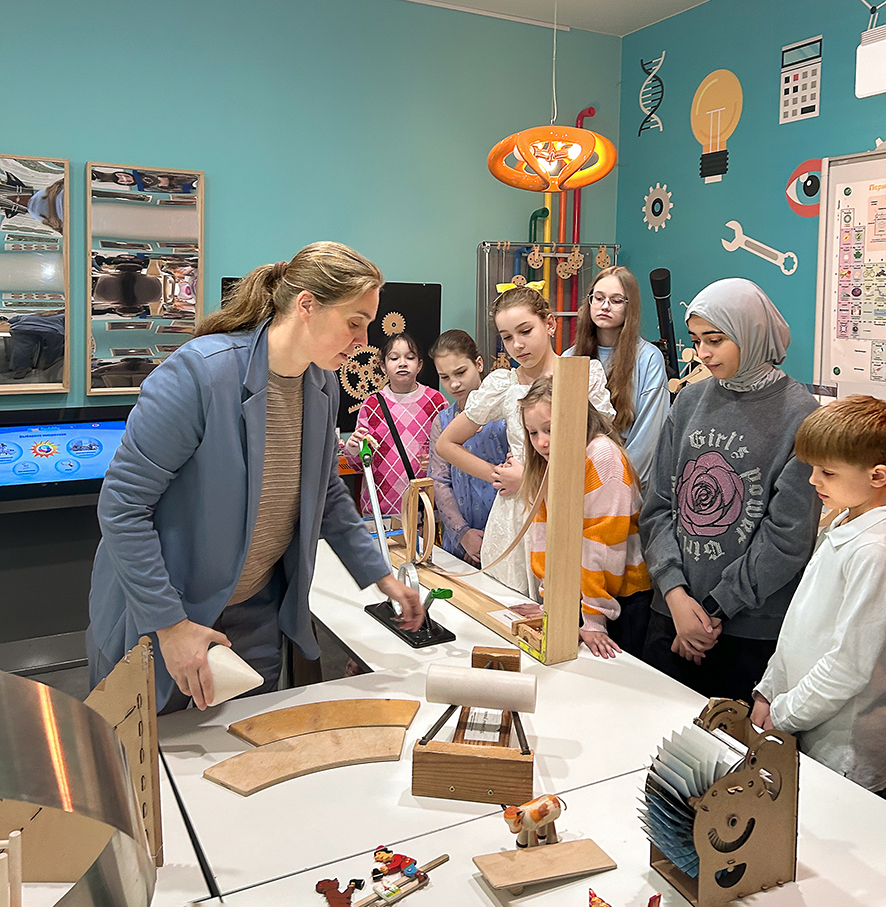
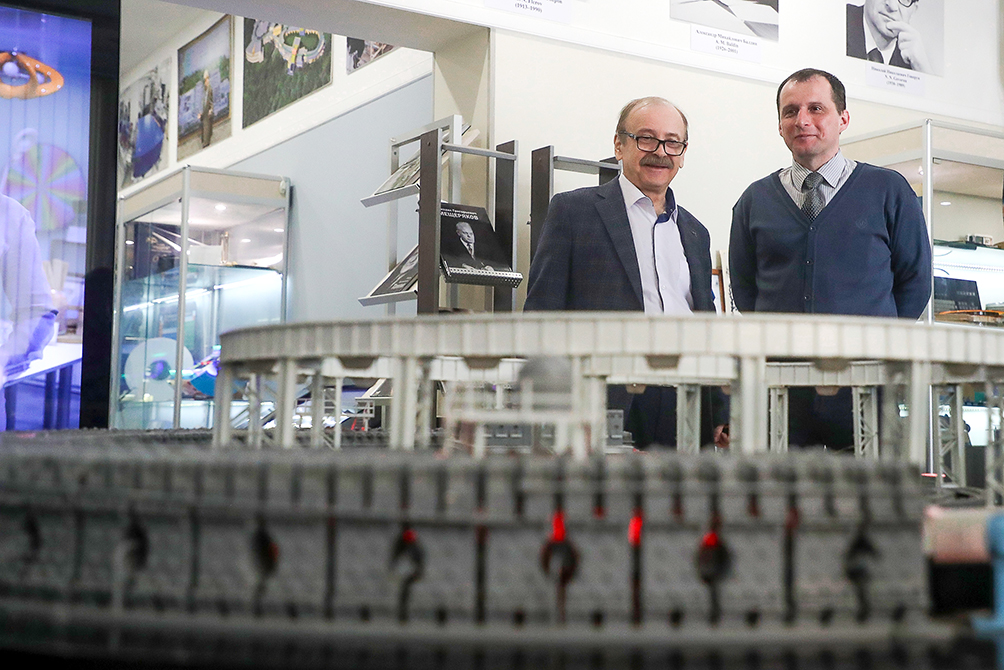
The Museum staff, for their part, prepared for adult participants an excursion with the history of the Institute's foundation, physical experiments for children and adults, as well as a demonstration of the Tesla's coil.
The atmosphere was very friendly. Adults bothered over the programme of the day and treats. Children moved around the halls with interest and studied the museum's experimentarium. After all the speeches, the discussion of cultural and historical facts continued in an informal setting. Now, guests could compare and share their impressions.
The participants told about how the meeting went.
Konstantin Vergel, a researcher at FLNP said,
"I was invited by my colleague from FLNP Norbert Kucerka. We also play hockey with him. I came with my wife and son, we had a great time. We learned a lot: the history of cooperation between Slovakia and JINR, the history of the holiday, about national traditions. We were surprised by the tradition of pouring water on girls. The son took part in a master class on weaving korbach from willow branches, saw various physical experiments together with other children. For adults, they gave an excursion-lecture on the history of the Institute's foundation, everyone listened with pleasure. Colleagues from Slovakia asked questions. They were surprised and glad to discover that their Czechoslovak colleague had once proposed the candidacy of M. G. Meshcheryakov to replace Director of MLIT. We congratulate the whole national Slovak group on the event."
Jan Bush Jr., a senior researcher at MLIT said,
"I really enjoyed our meeting. It is a pity that we have not held such a major event with guests before. I am glad that there were many children and they were able to learn about our traditions. Living here, there was no opportunity to participate in something like that. Today, I was at master classes. I was also interested in weaving korbach, I did it for the first time. I was convinced from my own experience that seeing on the Internet is one thing but doing it live is completely different. I realized that I needed to train to get better."
Ahmed Hassan Abdelrahman Elmekawi, a researcher at FLNP said.
"It was interesting for me to attend this event, it is a good opportunity to learn about the traditions of another culture. I looked through several books that were presented and in one of them, I saw photographs of Slovakia. What beautiful nature there is! I consider it a huge advantage of JINR to be able to unite different countries not only through science, but also through culture. In Egypt, Easter is also celebrated, eggs are decorated, treats are prepared. But there are no such rituals as in Slovakia.
I came with my daughter. We were at the JINR Museum for the first time. She spent time with other children in experiments and a master class and I was with adults on a tour of the Institute's facilities and history. The excursion was interesting and you don't need to be a scientist to understand it. It seems to me that everyone that lives in Dubna should visit the Museum in order to know how science originated and develops here. I focused on the history of the IBR-30 facility and how people used to do scientific work without advanced electronics. I saw how much work had been invested by JINR employees in the development of facilities from IBR-30 to Baikal-GVD."
Michal Hnatic,Head of Sector of BLTP said,
"The very meeting of the Slovak community in full force with family members and invited guests has become a holiday for us. We haven't had such events for a long time. There were two reasons to meet - Catholic Easter and the 70th anniversary of the Institute. As you can see, there are many young people and children here and we used this meeting to show ourselves and our friends our traditions. It is important to remember them and to create footholds for children and young people. The meeting was also a great opportunity for memories of the people that had created the history of JINR. I made a report and told about the history of cooperation between Czechoslovakia and JINR and later, Slovakia. Czechoslovakia was among the founders of JINR and one of the first Vice-Directors of JINR was Professor Vaclav Votruba from Czechoslovakia. Until the end of 1992, many good results were obtained together and we have something to be proud of. They have become an excellent starting point for strengthening and developing cooperation between institutes and universities in Slovakia and JINR after 1992. From a large cohort of Slovak scientists, including the younger generation, I would like to highlight the representatives of the generation of scientists that had started cooperation with JINR back in the 1960s and 1970s, whose experience was very much needed in meeting joint tasks today. First of all, I will mention the theoretical physicist Stanislav Dubnichka that for many years, has became the Plenipotentiary Representative of the Slovak Government at JINR and Professor Stefan Sharo that contributed to the discovery of new elements in FLNR and in the 1990s, became a member of the JINR Scientific Council.
I liked that at our meeting, there were many children who the museum staff showed to interesting physical phenomena on simple experiments and explained their essence. The children enjoyed experiments and master classes where they were active participants. For adults, the Museum staff organized an excellent tour of the history of JINR. I listened with pleasure, over time, it is interesting to rethink what you already know. In addition, in my opinion, the guide refreshes his story every time. I learned new information for myself that it was Professor Ivan Ulegla, a representative of Czechoslovakia, Vice Director of JINR from 1963 to 1967 that proposed to appoint M. G. Meshcheryakov as Director of the new LCTA laboratory established in 1966. It was nice to hear because Mikhail Grigorievich made a significant and decisive contribution to the foundation of JINR, leaving his indelible mark on the history of the Institute and our beloved city of Dubna."
Maria KARPOVA,
photos by the author
and Elizaveta BUTENKO
