
Electronic english version since 2022 |
The newspaper was founded in November 1957
| |
|
Number 16 (4814) |
For the JINR anniversary
Development of TOF neutron diffraction
The role of physicists from Poland
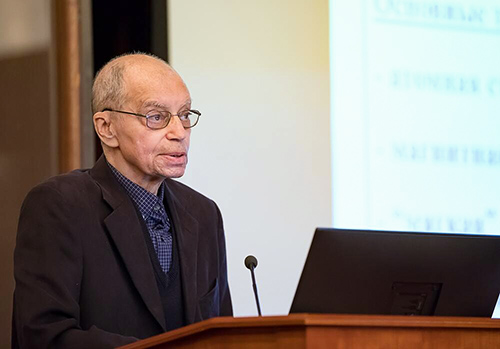
The People's Republic of Poland was one of 11 countries that established JINR in 1956. The Laboratory of Neutron Physics is preparing a collection of memoirs of FLNP employees from Poland and Russia about the history of the origin and development of neutron research in the field of condensed matter physics, the development of experimental facilities on the Laboratory's reactors. A chief researcher at FLNP Anatoly BALAGUROV is sharing his memories today.
The role of Polish physicists in the development of the neutron diffraction using the time-of-flight technique is well known and is not disputed by anyone in the world neutron community. At the same time, the history of the first TOF diffractometers (Time-Of-Flight) is often still not quite correct. In a review by F. Mezei, M. Russina, Gy. Kali "Time-of-Flight neutron diffraction for long pulse neutron sources" (Neutron News 23 (1), 2012) states, "The TOF technique for neutron diffraction was proposed 50 years ago by Polish physicists B. Buras and E. Lecievich as a very effective alternative to the technique using monochromator." In the biography of F. L. Shapiro, posted on the FLNP website, it is written, "F. L. Shapiro, together with the Polish physicist B. Buras, substantiated the use of the time-of-flight technique for diffraction investigations of the structure of matter." Like the previous one, this wording is not right.
How did everything really happen? The TOF technique in neutron spectroscopy has been known since the mid-1930s, when the first mechanical neutron flux chopper was constructed that was subsequently used by E. Fermi to monochromatize neutron beams. In 1956, a completely complete theoretical justification of diffraction using the time-of-flight technique appeared. Options for the technical implementation of the technique on both stationary and pulsed neutron sources were considered. In particular, P. Egelstaff that was then working at the nuclear centre in Harwell, in his report at the Crystallographic Congress (Paris, 1954) discussed the use of the TOF technique on a pulsed source to register neutron diffraction. In 1961, a symposium was held in Saclay (the nuclear centre of France) on the use of the TOF technique in neutron scattering. At it, P. Egelstaff made a review report in which, among other things, he presented a specific TOF diffractometer scheme.
Thus, TOF diffraction in the early 1960s was no longer something of a mystery. Here, for example, is a quote from a review article by I. M. Frank "Development and application in scientific research of the pulsed IBR reactor" (Particles & Nuclei, 2, 1972), "From the very beginning, when discussing the work scheduled on the pulsed fast reactor (IBR), it was obvious that diffraction at a given angle of reflection is not necessary for neutron monochromatization, since different neutrons satisfying the Bragg condition have different velocities and are separated by flight time." In fact, the matter was small - it was necessary to carry out a specific experiment. The discussion of the work scheduled for IBR-2 mentioned by Frank was in autumn, 1958 in Dubna at a meeting of scientists from JINR Member States on the subject of work on the first reactor already under construction. The following year, I.M. Frank paid a visit to Poland, where there was a specific conversation on the arrival of Polish physicists in Dubna to begin work on condensed matter.
Bronislaw Buras that at that time worked in Sverka (the nuclear centre of Poland), at the Institute for Nuclear Research, was not present at the meeting in Dubna. But as he writes in his memoirs, he was at a symposium in Sakla, listened to Egelstaff's report and it was this report that prompted him to try to practically implement the ideas expressed in it. B. Buras and colleagues carried out the first experiments at the two-megawatt EWA reactor in Sverka. The pulsed neutron beam (with a pulse width of ~ 80 μs) was produced by a chopper, the full flyover base of the chopper - sample - detector was about 5 m. The neutron flux was small and the measurement of the very first neutronograms took up to 40 hours with the mass of the sample (metallic Al) about 200 grams. Their main goal was to experimentally confirm the performance of the technique and it was achieved. Based on the results of these first experiments, an article was written, published in the journal Nucleonika, in which the main advantages of the TOF technique were clearly formulated - the ability to register the diffraction spectrum in a wide range of interplanar distances (dhkl) at a fixed scattering angle and high resolution by dhkl.
In his memoirs, Buras writes that for the next stage of work - testing the basic interactions between the intensities of diffraction peaks and their structural factors, it was necessary to dramatically improve the quality of neutronograms that was estimated using the aperture and resolution of the diffractometer. The pulsed neutron source that could provide it had already started to operate at FLNP JINR and in 1963, B. Buras and his employees I. and E. Sosnovskys arrived in Dubna. Buras soon had to return to Poland and specific work was carried out by the Sosnovky couple. In addition to them, an employee of FLNP V.V. Nitz and a graduate student of Moscow State University Z. G. Papulova participated in the research. They constructed a TOF diffractometer on one of the IBR beamlines with a full flight base of about 16 meters, with a detector based on a mixture of ZnS(Ag)+10B2O3. The quality of the measured diffraction spectra was indeed much better than in Sverka, although the data set time was still excessively long (more than 10 hours on the simplest compounds). The results of the first and some subsequent experiments were published in the JINR preprint and a review article in the journal Nukleonika.
After modernizing the detector system of the diffractometer and increasing its aperture due to geometric focusing, I. Sosnovska and colleagues carried out the first experiments aimed at meeting a specific structural problem. Namely, it was decided to try to estimate the orientation of the magnetic moments of iron in the BiFeO3 compound. The problem was met thanks to one of the properties of the time-of-flight technique - good resolution with large dhkl. In his memoirs, I. Sosnovska emphasizes that experiments with BiFeO3 were the first successful application of the TOF technique to obtain new structural information about the magnetic structure of the crystal. These results were the basis of the thesis that I. Sosnovska defended in Warsaw in 1967. In 1965, a significant visit of one of the pioneers of neutron diffraction, the English physicist J. Bacon to Dubna took place. In the archive photo, he, together with Sosnovskys and one of the founders of neutron diffraction in the USSR R. P. Ozerov, is discussing the results obtained at IBR. Bacon subsequently sent a comparative analysis of the diffraction spectra measured at IBR and at the stationary reactor at Harwell to Dubna. It turned out that the resolution of the diffractometer on IBR is five times better than on the diffractometer in Harwell.
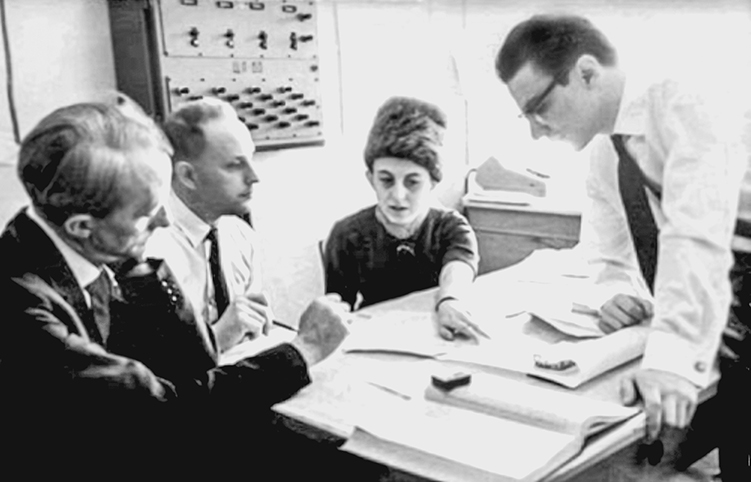
J. Bacon, R. P. Ozerov, I. Sosnovska, E. Sosnovsky, 1965
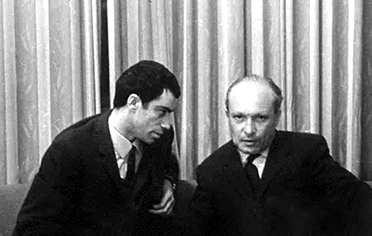
A. M. Balagurov and F. L. Shapiro, 1970
At this time, the Sosnovsky couple in Dubna was replaced by another Polish couple - Jadwiga and Andrzej Holas that also made a significant contribution to the development of TOF neutron diffraction in Dubna. J. Holas participated in the research of the Yu. A. Aleksandrov’s group on measuring the amplitude of the n-e interaction and together with another representative of Poland E. Maliszewski co-authored several diffraction papers. A. Holas played a major role in the development and experimental verification of the geometric focusing conditions of TOF diffractometers. In experiments with polycrystals, this technique allows you to significantly (almost five times) increase the aperture of the diffractometer without a noticeable deterioration in resolution and continues to be widely used to date. It is believed that it was independently and almost simultaneously proposed by J. Carpenter in the USA (there is a publication in 1967) and A. Holas in Dubna and was first implemented on the IBR reactor (there is a publication in 1968). In reality, the first publication was made by A. Holas in 1966 as a preprint of the Institute for Nuclear Research in Warsaw. Moreover, I. Sosnovsk writes in his memoirs that the focusing effect was accidentally discovered back in 1965 in an improved design of a diffractometer for IBR and was understood by F. L. Shapiro. It is not known for certain but apparently, it was F. L. Shapiro that recommended A. Holas to write the necessary formulae that he had carried out.
In subsequent years, many physicists from Poland continued to make a significant contribution to neutron diffraction investigations on IBR reactors at FLNP JINR. J. Domoslavsky from the Institute of Nuclear Physics in Krakow took an active part in the development of the DN-2 diffractometer at the IBR-2 reactor. In the investigations of phase transitions in ferroelastics, B. Mroz from the Institute of Physics in Poznan participated. Several important investigations on the structure of high-temperature superconductors were carried out at IBR-2 together with A. Payachkovskaya, J. Pekhota and H. Szymczak from the Institute of Physics of the Polish Academy of Sciences (Warsaw). Very interesting results on the kinetics of structural phase transitions were obtained on samples of substituted spinels brought to Dubna by I. Yatsyna-Onyshkevich from the Institute of Physics in Poznan. These experiments were carried out on a TOF diffractometer DN-2 with constant scanning at temperatures up to 800 K and measuring diffraction spectra every 80 seconds. In those years (1993), such a high-speed measurement of neutron diffraction spectra was possible only at the IBR-2 reactor.
It is known that even more actively than in the work on neutron diffraction, Polish physicists participated in the development of the inelastic neutron scattering technique on IBR reactors. These investigations were held under Professor E. Yanik and for their implementation, a special group was formed at FLNP that included physicists from Krakow and Poznan. For a long time, this group was headed by Ireneusz Natkanets.
Olga TARANTINA
