
Electronic english version since 2022 |
The newspaper was founded in November 1957
| |
Historical overview
Under the sign of antisigma-minus-hyperon
Institute Dubna - 1960
To explore is to see what everyone sees
and to think like no one thinks.
Albert Szent Gyorgyi
Many years later, having decided to write the story of the discovery of antisigma-minus-hyperon, Anatoly Alekseevich Kuznetsov, Advisor to JINR Directorate, could no longer remember exactly when it had happened - at the very end of January or at the beginning of February. But he remembered for sure that it was Sunday, he worked the second shift and in the work room, on other days crowded and noisy, there were only two of them - he and his peer Vlad Ivanov from the Laboratory of Nuclear Problems: "There was an unusual silence... Vlad in the opposite corner of the room was counting something on the "Mercedes" and burying myself in the stereo, I was looking at the film left for me after the first shift... Sometimes, I asked Vlad to come up so that he would look at the picture I had discovered; Vlad easily broke away from his calculations and with great interest joined in the discussion of my hypothesis..."
This all continued until in the next "star" Anatoly Kuznetsov, as he writes, saw something strange: two "forks" looked at the top of the star, which traces of secondary particles fanned out from - the decay products of some two strange particles; these could be lambda hyperon or K0 meson.
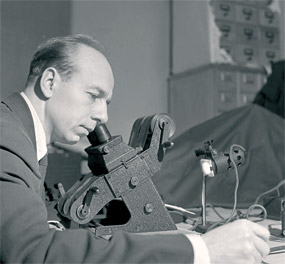 |
| The discoverer of antisigma-minus-hyperon Anatoly Kuznetsov. Photos by V.A.Shustin |
A preliminary estimate of the pulse of secondary particles generated by the decay of the supposed neutron showed that it could not be a neutron in any way. And the antineutron, annihilated on the carbon core, could. So... In the memoirs of A.A.Kuznetsov, there is nothing about the excitement that swept him at this thought. But it doesn't matter - we can easily imagine it!
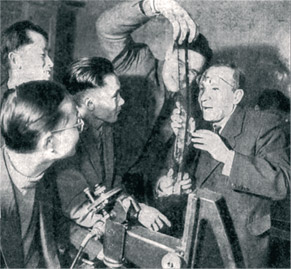 |
| Kim Hee-In, Ding Datsao, Nguyen Ding You, Alexander Mihul, V.I.Veksler. The picture is clearly staged, yet it is lively and reflects the temperament of Vladimir Iosifovich |
A month and a half of hard work was crowned with success: the hope that a new particle was discovered by the international staff of LHEP turned into confidence. Director of the Laboratory V.I.Veksler picked up the phone and called Director of JINR D.I.Blokhintsev, D.I.Blokhintsev called the editorial office of JETP and asked to delay the release of the next issue of the magazine. And early in the morning of 24 March, 1960, the discoverer of the new antiparticle Anatoly Kuznetsov urgently left for Moscow with a manuscript of the article.
V.I.Veksler was finally able to say, "Now, we, as they say, justified the construction of the synchrophasotron"1. Journalists poured into Dubna in a stormy stream. Among the journalistic fraternity was the popularizer of science Daniil Danin - and as a result, the modest hero of antisigma-minus-hyperon got on the pages of the book "The inevitability of a strange world",
"And on the first spring sun under Dubna pines, a man in a laboratory gown unfolded a big photo in front of us. On a black background - a random blizzard. With the hand of physics, thin colored lines are drawn that distinguish the main trace and its ramifications from a snowstorm.
"And that's all?" disappointment sounds in the journalist's voice. "Are you sure that it is your antisigma-minus?"
The man in the dressing gown smiled.
"On the eye, of course, it cannot be said, but detailed measurements and calculations..."
"But is it possible to count all the traces? There are hundreds of them in this one photo!"
The man in the dressing gown smiled again.
"You see, something can be discarded immediately: protons, electrons... And then..." the man hesitated for a moment. "You know, I somehow felt..."
"So, you found it first, didn't you?"
"Yes, in short, so..." the man in the dressing gown reluctantly confessed..."
When the book was published, a man in a lab coat wrote to the author,
"If I knew that you would write about it, I would tell you about my comrades that did so much for this discovery. It is difficult to see this event but each of us could see it, yet making a chamber, getting thousands of photos, processing them is only within the power of a larger team of people. And our group is wonderful, friendly and essentially international: Wang Tsu-Tzen and Ding Da-Tsao (China), Nguyen Ding You (Vietnam), Kim Hee Ying (Korea), I.Vrana (Czechoslovakia), A.Mikhul (Romania), E.N.Kladnitskaya, A.V.Nikitin, M.I.Solovev, N.M.Viryasov (USSR). We established this group, scientists (from recent students) were made and were taught to work by Academician V.I.Veksler - a great scientist and a warm, attentive person and Professor Wang Ganchan, whom our comrades remember with great warmth even now (he is currently in China). A huge contribution to this work was made by M.I. Solovev that developed the bubble chamber - a device which it would be impossible to get a photograph of our particle without. This list could be continued... 2 Today, physics is rarely done by one person."
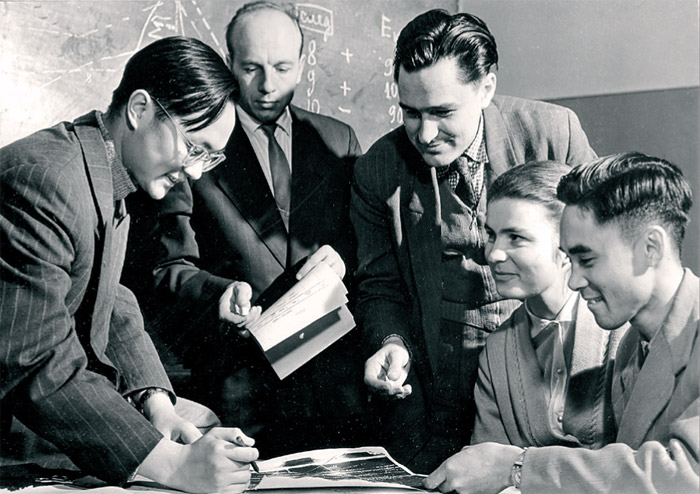
Dean Datsao, A.Kuznetsov, A.Mikhul, E.Kladnitskaya, Nguyen Din You. Photo by TASS correspondent A.S.Batanov
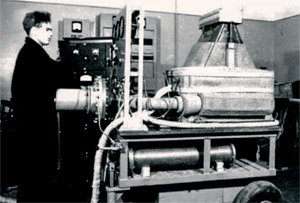 |
| The same 24-liter propane chamber which antisigma-minus-hyperon was discovered on and 24 theses were defended; how they like to add to LHEP - a liter per brother |
Antisigma-minus-hyperon (along with synchrophasotron) for many years had been a symbol of the Institute Dubna, a trademark of JINR scientific products (today, its place is taken by the element 105 - dubnium). But there were other, no less significant events of the 1960 scientific Dubna: in summer, IBR-1, the world's first pulsed nuclear reactor was launched at the Laboratory of Neutron Physics and in autumn, at the Laboratory of Nuclear Reactions - the launch of the U-300 cyclotron, the world's best heavy ion accelerator at that time.
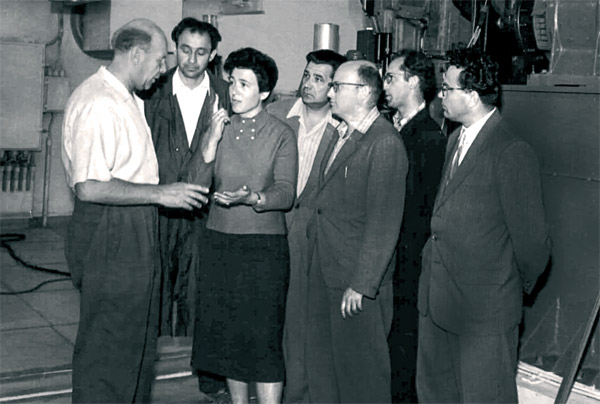
IBR launch team: D.I.Blokhintsev, S.K.Nikolaev, Yu.A.Blumkina, F.I.Ukraintsev, Yu.Ya.Stavissky, V.P.Zinoviev, S.G.Skvortsov
That year, the Dubna physicists faced a problem that in a few years, would result in the establishment of another laboratory - LCTA. As V.I.Veksler reported at the autumn session of the Scientific Council, out of 2000 images gained, only 200 were processed for the next Rochester Conference. The process was inhibited at the stage of mathematical processing on a computer. At that time, the only operating computer in JINR was the Ural-1 machine, completely unsuitable for mass processing of experimental data: it lacked RAM that reduced its speed to 100 operations per second.
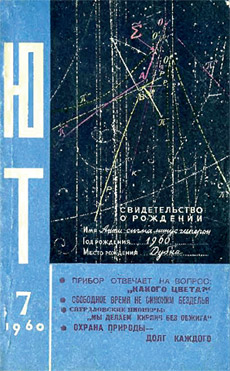 |
| The cover of the magazine "Young technician", published in a circulation of 250 thousand copies. How many young technicians after that decided to dedicate their lives to physics? |
The second, defunct copy was bought by Dubna. From the memoirs of Raisa Dmitrievna Govorun, "At that time, our M-20 was the best machine. And Govorun began to slow down the directorate..." And this is what the Administrative Director of JINR V.N. Sergienko answered him, Raisa Dmitrievna continues, "You still ask me for a star from the sky! Where will I get you this machine? You will have "Kyiv". And they went to Kyiv... Nikolay returns gloomy, says that the Institute will buy a machine but it is absolutely raw and we are invited to bring it to mind. They brought the machine, began to establish..."
But it was not possible to bring to mind. From the story of Henrietta Nikolaevna Tentyukova, one of the first three mathematicians-programmers of Dubna that came by distribution in 1953, when the Institute Dubna consisted of almost one State Tretyakov Gallery, "And it continued until M-20 was bought... Oh, no, my brothers, there was also "Kyiv"! "Kyiv" is an epic. It's something so horrible. It, in general, never operated. Lida Nefedieva and I sat down to write elementary functions for him. Memory was very limited, I had to save every cell and Lida and I were sophisticated. But "Kyiv" never operated, although the people of Kyiv constantly redid it and asked us to wait another ten to fifteen minutes and we sat on it all Sundays. Therefore, I did not remember the appearance of the M-20 clearly, there was one light in the window, "Kyiv", we suffered for a long time."
A year and a half were wasted. In the end, Govorun proposed connecting the memory of "Kyiv" to an operating M-20 and this was the first experience of machine-to-machine communication in the USSR. From the memoirs of Alla Ilyinichna Efimova that worked at that time as an engineer in a computing centre, "Perhaps the most joyful event in this epic was the sale of Kyiv at a similar price to the Sevastopol Institute of Oceanology, together with engineers Yury and Lydia Shchetinins."
And finally, another event of that year, not directly related to science, but important for the Institute Dubna was: in a pine forest in the Chernaya Rechka, not far from Lesnaya Street, "Peak Tyapkina" was erected - a favorite resting place for Dubna residents. The peak turns 66 this year. Age makes itself felt - it is noticeably donkey, rang out in the shoulders, yet it is still popular and in winter, children sled on it, as before, with delight and more than one golden cloud spent the night on its chest.
Notes
1 At the next Rochester Conference, Luis Alvarez attacked V.I.Veksler with the question: what about the D-particle? but did not receive an unambiguous answer. And a year later, the question disappeared by itself: as they say in such cases, "the effect has resolved".
2 At the end of the year, 15 people became winners of the first JINR prize for participating in antisigma-minus-hyperon research. Among them is Vladilen Germanovich Ivanov, an employee of the Laboratory of Nuclear Problems, the same Vlad from the memoirs of A.A.Kuznetsov. But Vladilen Germanovich was not included in the list of co-authors of the discovery.
Alexander RASTORGUEV
