
Electronic english version since 2022 |
The newspaper was founded in November 1957
| |
Workshop "Baikal-GVD 2026 Neutrino Telescope"
In a few years, the efficient volume of the Baikal-GVD Telescope is scheduled to be increased to one cubic kilometer and by 2040, a new generation HUNT neutrino telescope with a volume of up to 30 km3 will be constructed in the water area of the deepest lake in the world. The project will be implemented by the Baikal-GVD collaboration together with the specialists from the Institute of High Energy Physics of the Chinese Academy of Sciences (IHEP). These plans were announced by Director of the Joint Institute for Nuclear Research, Academician of the Russian Academy of Sciences Grigory Trubnikov at the Workshop "Baikal-GVD 2026 Neutrino Telescope" that was held on 25 - 28 February in the village of Listvyanka (Irkutsk Region, Russia).
Specialists from JINR, from the Institute for Nuclear Research of the Russian Academy of Sciences (INR RAS) and from a number of Russian universities discussed the status of the largest facility in the Northern Hemisphere for studying neutrino fluxes and a major expansion of research infrastructure in the future.
"We increase the pace of work in order to bring the efficient volume of the telescope to one cubic kilometer by 2028 and take a leading position in the world," Grigory Trubnikov said. "The detector of a new generation, which we will work on together with colleagues from China, will allow meeting problems not only in the field of neutrino astrophysics, but also in geophysics and environmental monitoring. This is an ambitious goal but we can do it, especially given the support of JINR Member States and partners."
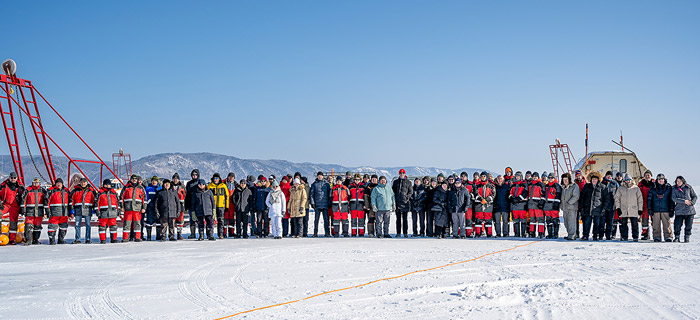
Director of the Joint Institute also announced the transition to a new stage in the development of the coastal infrastructure of Lake Baikal. As early as 2026, at the 107th kilometer of the Circum-Baikal Railway, the construction of an advanced base for 120 specialists will start.
Head of the Laboratory of High Energy Neutrino Astrophysics, INR RAS Jean-Arys Dzhilkibaev made a report on the current state of the Baikal-GVD mega-science project. Today, the Baikal Neutrino Telescope collaboration brings together about 80 researchers from 5 countries. Over the past ten years, the detector has increased from 1 to 14 clusters, including 119 garlands and 4284 optical modules. According to the results of the 2025 expedition, the efficient volume of the neutrino telescope reached 0.7 km3.
According to Jean-Arys Dzhilkibaev, Baikal-GVD is also widely used as a testing ground for new generation technologies. Two experimental garlands with fiber optic data transmission were put into operation at the facility, as well as two prototype garlands of the HUNT neutrino telescope, deployed jointly with Chinese colleagues from IHEP.
The 2026 expedition plan includes the installation of another prototype of HUNT garlands and two optical modules with 20-inch photomultipliers. Over the next three years, scientists are going to bring the detector volume to 1 km3 and the number of modules - to 6,000 by adding eight inter-cluster garlands with laser calibration light sources and four extra experimental garlands.
DLNP Deputy Director Dmitry Naumov in his speech focused on the imbalance in the number of personnel: if the Baikal-GVD collaboration has about 80 people, then experiments such as KM3NeT, IceCube, JUNO and DUNE bring together from 250 to 1400 specialists. "We need to close the current personnel gap and to hold systematic training of specialists in order to provide the number of people that neutrino physics requires," the scientist emphasized.
The answer to this challenge will be the launch of a new educational programme "Neutrino Physics and Particle Astrophysics" that is currently implemented by JINR together with Lomonosov Moscow State University and the Teach-in online platform. The programme is based on a modular principle: a common basic core, including the basics of neutrino physics and data analysis, is complemented by two specialized tracks - theoretical and experimental, providing for in-depth courses. Integration disciplines cover multichannel astrophysics, gravitational-wave research and a review of next-generation neutrino facilities. The key to preparation will be work on real research projects under the supervision of the working scientists. It will allow graduates to immediately join the activities of leading scientific organizations. The start of the programme is scheduled for 2026.
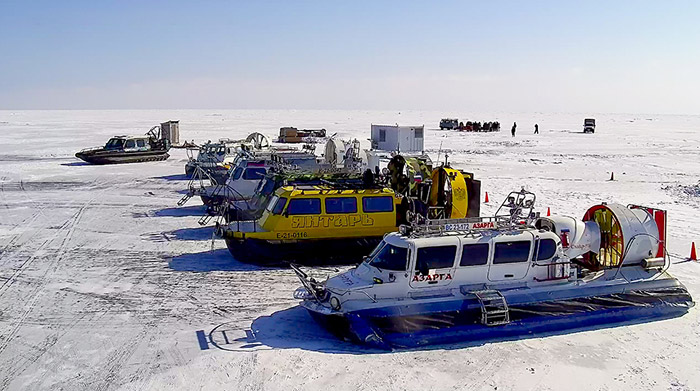
In addition to plenary reports, specialists from the INR RAS, LPI, NSU, ISU, MEPhI and KBSU presented their reports on the implementation of state assignments in the field of neutrino physics and astrophysics. The colleagues from the Research Institute of Nuclear Physics of Moscow State University spoke about the work carried out, the representatives of ITMO University shared plans for their participation in the Baikal neutrino project. The meeting participants also visited the Ice Camp at 107 m km of the CBR - the site of the deployment of the Baikal Neutrino Telescope, where they learnt about the progress of expeditionary work and watched the immersion of the new optical module live.
JINR Press Office,
photos by Bair Shaibonov and from the collaboration archive
