
Electronic english version since 2022 |
The newspaper was founded in November 1957
| |
|
Number 46 (4794) |
Institute day by day
On worldwide experiments in high energy physics
On 12 November, the 100th Seminar of the Association of Young Scientists and Specialists of JINR was held at the Scientists' Club. Three and a half years ago, the members of the AYSS Council organized weekly popular lectures at the Joint Institute, where the staff members from various departments of the Institute give each other popular lectures to share their professional interests. JINR Director and RAS Academician Grigory Trubnikov presented a paper "Future experiments in high energy physics" at the anniversary seminar.
The lecturer first addressed issues in modern physics that are not met by the Standard Model of elementary particles (SM) and that need to be tested in accelerator experiments. He identified four main vectors for the development of high energy physics. The first consists of precision experiments at the highest possible energies to test the parameters of the Standard Model, as well as the search for rare or forbidden decays and transitions. The second is research within the SM framework, such as studying CP violation, testing QCD predictions, studying the internal structure of the nucleon and others. The third vector of development includes experiments investigating the behavior of nuclear matter under extreme pressures and temperatures (such conditions occur, for example, in the cores of neutron stars). The fourth is the search for new physics beyond the SM.
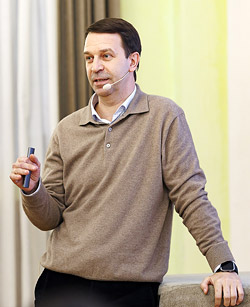 JINR Director presented an overview of global accelerators and laboratories engaged in high energy and particle physics in Switzerland, the United States, China, Russia, Japan and other countries. China currently leads the world in terms of facilities announced and under construction. In the 2040s, the FCC (CERN) or CEPC (China) is expected to become the world's largest accelerator, with a perimeter of 100 km. Grigory Trubnikov identified the development of an international collaboration of 10,000-20,000 physicists and engineers as the main challenge in designing such a machine.
Grigory Trubnikov discussed various types of accelerators, including colliders, their key properties and technical features, the most important parameters, that are intensity and luminosity, as well as current beam focusing systems. He also focused on flavor factories (the already operating BES-III and Belle-II, the scheduled STCF and Belle-II Upgrade), as well as the LHC, RHIC, FAIR and HIAF electron-ion colliders.
Neutrino physics has a special place in high energy physics. It is studied not only using accelerators, but also at neutrino observatories, nuclear power plants and in major neutrino oscillation experiments (JINR is represented in the NOvA and DUNE projects that have recently yielded significant results). JUNO, an underground observatory constructed in China with the active engagement of JINR scientists, engineers and programmers, has recently launched its first physics experiment and boasts the highest accuracy and fastest data storage.
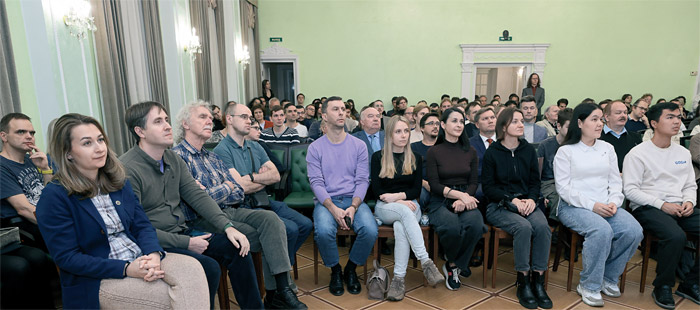
At the end of the popular science lecture, the speaker described the NICA Accelerator Complex and highlighted the role of JINR's flagship facilities in the global landscape. "JINR has a well-balanced programme in high energy physics and we are still a player in international experiments. NICA will soon be launched and together with Baikal-GVD and the Superheavy Element Factory, we will have three major facilities in operation, each of which will occupy one of the top 3-5 positions in the world in its class," Grigory Trubnikov emphasized.
In concluding the seminar, JINR Director outlined a few unapproached theoretical issues. Will the cosmic microwave background waves be confirmed, allowing scientists to confirm the currently dominant theory of the inflationary expansion of the Universe? Does gravity operate on microscales and could a Grand Unified Theory be developed that would take gravity into account in addition to the three forces? Why is time as a dimension not symmetrical, but has a preferred direction?
JINR Press Office