
Electronic english version since 2022 |
The newspaper was founded in November 1957
| |
|
Number 39 (4787) |
Youth and science
Incredible emotions and a test of strength
In early September, the third popular Science Forum "Nuclear Festival" was held at the MEPhI Countryside Sports and Educational Complex on the banks of the Volga River in the Tver Region. It was organized within the framework of the Decade of Science and Technology in the Russian Federation.
This is Russia's first major Science Meets Music event that brings together science, art and sport. The Festival aims at popularizing scientific knowledge, attracting talented young people to research and development, as well as strengthening cooperation between the scientific community, educational institutions and industrial partners.
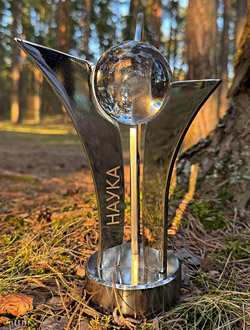 The Festival programme includes popular science lectures featuring leading science communicators, interactive exhibitions, scientific experiments for children and adults, creative collaborations with representatives from creative universities such as Stroganov, VGIK and GITIS, as well as musical performances and open-air film screenings as part of the FANK Festival of contemporary scientific films. Focus is on the Nuclear Cup - a competition between eight councils of young scientists from leading Russian scientific organizations and universities (including MEPhI SMUS, NINP MSU, JINR, Rosatom State Corporation, NRC Kurchatov Institute, FEFU and MIPT) that competed for the main trophy in intellectual, athletic and creative competitions.
Ultimately, the JINR team won the Nuclear Cup. A researcher at DLNP Vladislav Rozhkov told our newspaper about the dynamic and exciting competition.
"We arrived at the camp "Volga" late in the afternoon, quietly, with boxes of props, cables, tents, sleeping bags, camping gear, badminton rackets and duct tape that is known to save the day in almost any situation. As we entered the camp, we smelled pine needles and the anticipation of a great competition: stages were being set up, a sound check was underway, volunteers were connecting cables, performers were rehearsing somewhere and in the next tent, people were debating how to properly fence off the camp. We immediately realized that this festival was more than just an event, but a test of team cohesion: quick action, mutual support and the ability to take a hit.
On the first night, we set up our tent camp. It wasn't just "cabins" but a fully-fledged base with a laser show: beams of light shot into the sky next to our tents and participants passing by paused, marveled and smiled. I think, it set the tone for our stay at the Festival - to do everything just a little better than "good enough".
In the morning, after breakfast, we assigned roles and quickly checked our schedules: some were off to the lecture, some - to laser tag and some were still setting up the tent camp.
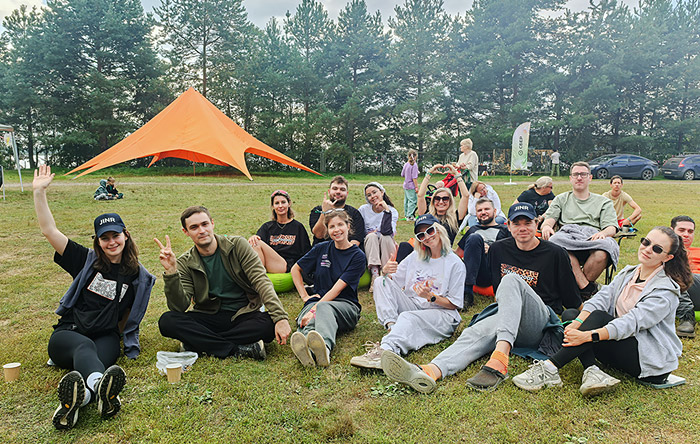
The competitions followed one another closely. Our musical performance wasn't just a show for show's sake, but a precise emphasis on the idea: rhythm, lyrics, a touch of self-irony, so the audience applauded because they enjoyed it, not because the performance was over. In the competition "Lectures", I tried to make each slide work as a thesis: facts, conclusion, benefit. Unfortunately, the equipment failed and the video didn't start.
"Particle throwing" that was essentially pushing nuclei of different masses was a special joy. "Pushing π-mesons", "Throwing electrons" and "Throwing a K-meson" sound like inside jokes, but in reality, they were a test of precision, a sense of significance and... frayed nerves. We weren't showing off, we just did it carefully and quickly.
In "Chess", Maxim Podlesnyy played a classic game: positional pressure, without heroics. The competition "Meeting tasks" is, as they say, our "home ice," our advantage over other teams. We conquered a couple of difficult spots not by force, but by marking our approaches, as in a regular research project. The experience of Maxim Podlesnyy and Elizaveta Konstantinova helped. The "Hero race" reminded us that endurance is also part of the profession: if you have the patience to endure a long experiment, you can master the course. Ekaterina Kolosova, Lidiya Dodonova, Maxim Podlesnyy and Viktor Baryshnikov performed superbly.
Ilya Veselov directed the video - a wonderful script, top-notch acting and a thorough exploration of the video's topic "A festival participant who pretends to be a scientist". The quiz proved an intellectual outlet after a day of sports. But even here, the task-sharing mechanisms kicked in: one of the participants answered questions on history, another - on physics and a third tried to find clues in the questions themselves.
The theatrical production was a rare opportunity for us to indulge our emotions and it worked because the emotions were evoked by the script, the acting and the direction, not by any desire to create a dramatic effect. Regina Kozhina, Kirill Petukhov and Nikita Yushin did a complete job. If you haven't seen it, I highly recommend it!
We won sports - badminton, beach volleyball - not through "talent" but through confident, mutual support. Lidiya Dodonova, Dmitry Chereshkov, Alexander Selyunin, Nika Bykova and Dmitry Krivenkov carried the weight of the entire team. Unfortunately, it was a two-on-two game! In the board game "Ekivoki," we laughed ourselves and so did the other players at our table - that's a special skill when you need to quickly find common ground. Dasha Shamina played for us and I was the team captain.
We received top marks for the tent camp - for precision, concept and that very "businesslike atmosphere" with laser effects. Thanks to Alexey Kuznetsov, we couldn't have done it without him! All this united produced the main result: we were first in many disciplines, consistently among the leaders in others and ultimately, the quantitative results added up to the highest award - the Nuclear Cup.
I remember the moment before the results were announced. We stood there, silently waiting, some fiddling with their fingers, some looking up at the sky, some frozen in anticipation... A stack of diplomas for the prize winners appeared and it was clear who the winner was. We ran onto the stage as a team. But when they announced, "JINR - first," I clearly realized we weren't happy about the Cup. We were happy that for three days in a row, everyone had done their job as if everything depended on it. And indeed, it did!
I think, this festival turned out to be a kind of mirror. It showed us how we can talk simply about complex things; how, under stress, we don't fall apart, but come together more closely; how we can be different - lecturers, engineers, athletes, musicians and still remain one team. And it also became clear that engineers, theoretical and experimental physicists and specialists in other sciences and fields do not live in parallel worlds. Communicating with other teams and exchanging contacts are pleasant and I hope, useful benefits of the Festival. Tomorrow, joint projects will grow out of it.
By the time we left, all the teams' tent camps had already been dismantled, the stage had gone dark and our heads were swirling with to-do lists for the week ahead. Winning is great. But most importantly, we left with incredible emotions, new friends and the confidence that we're capable of tackling even more complex projects. It means we did everything right. The Cup is ours. And the work goes on."
JINR was represented at the Nuclear Festival by the staff members from Russia, Vietnam, India and Bulgaria: Lidiya Dodonova, Alexander Selyunin, Ekaterina Kolosova, Daria Shamina, Kirill Petukhov, Alexey Kuznetsov, Viktor Baryshnikov, Elizaveta Bokova, Dmitry Chereshkov, Vladislav Shalaev, Vladislav Rozhkov, Elizaveta Konstantinova, Ilya Veselov, Hussein Karatash, Varvara Fufaeva, Nina Bykova, Maxim Podlesnyy, Dmitry Krivenkov, Regina Kozhina, Oleg Samoilov, Rivu Adhikari, Natarajan Marimuthu, Nikita Yushin, Cao Van Hai and Nguyen Thi Minh Sang.
Congratulations to our colleagues on their well-deserved victory!