
Electronic english version since 2022 |
The newspaper was founded in November 1957
| |
|
Number 39 (4787) |
Seminars
The level of the reports is, as always, high
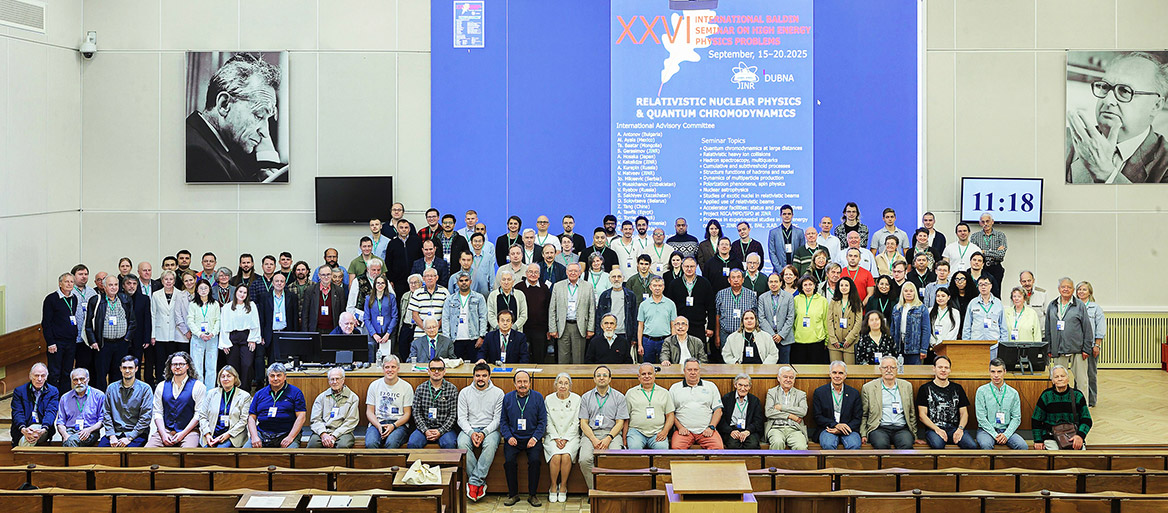
On 15 - 20 September, the 26th International Baldin Seminar on High Energy Physics "Relativistic Nuclear Physics and Quantum Chromodynamics" was held at VBLHEP JINR.
Doctor of Physics and Mathematics, Head of the Department of Heavy Ion Physics at the Laboratory of High Energy Physics and Co-Chair of the Organizing Committee Professor Alexander MALAKHOV spoke about the Seminar's development, topics of these reports and future plans.
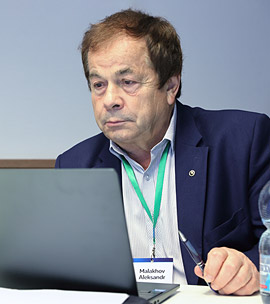 |
| Alexander Malakhov |
- Of course, Yuri Oganessian, Academician of the Russian Academy of Sciences and Scientific Leader of the Laboratory of Nuclear Reactions. The thing is, work in Yuri Oganessian's Laboratory isn't exactly our area of expertise; we work at high energies here. But we put his report first because it turned out that the science was generally unified. Yuri Oganessian has historically been involved in the synthesis of superheavy elements at the Laboratory of Nuclear Reactions. As it is well known, element 118 -oganesson was named after him.
The current focus isn't just on higher atomic numbers. Neutrons that are abundant in neutron-rich nuclei also manifest themselves in lighter nuclei. And how neutrons interact is still unclear. It turns out that these light, neutron-rich nuclei can be produced. It doesn't require high energies, but the energies available at FLNR are insufficient. We need an energy of about 300 MeV that we happen to have thanks to the development of the NICA booster. We've already completed part of the accelerator complex -we've built the booster, it's up and running and this preliminary accelerator operates precisely at energies up to 600 MeV. Therefore, the idea arose to use this already operational part of NICA for the programme to study light, neutron-rich nuclei. This is essentially a new, separate field and Yuri Oganessian believes it's very important.
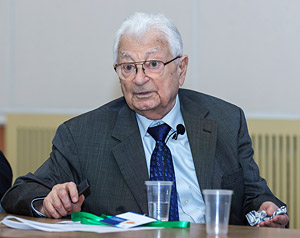 |
| Yuri Oganessian |
The second major talk was supposed to be given by Academician of the Russian Academy of Sciences and Scientific Leader of JINR Victor Matveev but he unfortunately fell ill. Since this talk was of interest to many, we posted it on the seminar website. It's a jubilee talk, one might say, related to the discovery of quark color 60 years ago. V.A.Matveev and A.M.Baldin, along with P.N.Bogolyubov, R.M.Muradyan and A.N.Tavkhelidze were awarded the Lenin Prize for the discovery of color. We set up a poster displaying an excerpt from the newspaper "Pravda" reporting it.
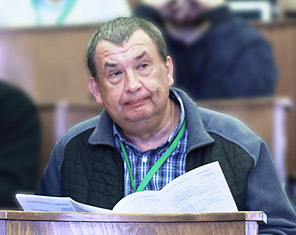
A leading researcher at VBLHEP Arkady Taranenko gave a fascinating report. It covered 25 years of heavy ion research at the RHIC collider in the United States. Taranenko presented the results obtained at the large PHENIX and STAR facilities, in which JINR staff actively participate.
Vladimir Karmanov (LPI), a profound theorist whose research is renowned worldwide, gave an interesting report. He presented a specific problem on a new structure function for He-3.
 |
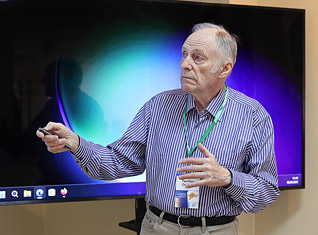 |
| Arkady Taranenko | Grigory Feofilov |
Grigory Feofilov from St. Petersburg State University supervises a large group of young people he has brought with him. They participate in major experiments, particularly, at CERN. His report is related to the scheduled research at NICA and they are actively involved in the preparation of the experiments.
The reports by our four Mongolian comrades are noteworthy. Tseepeldorj Baatar is the supervisor. These reports are directly related to the investigation of Alexander Baldin. He proposed studying nuclear interactions in four-dimensional velocity space, introduced the cumulative number and under him, the cumulative effect was discovered. Mongolian researchers develop these ideas related to the cumulative effect and they have achieved very good current results based on experimental data previously obtained both at JINR and at the accelerator in Protvino.
What is the level of the reports and speakers this year?
- The level of the reports is, as always, high. Registration is open to everyone, but when we put together the programme, of course, we undergo analysis. First, we divide it into sections, for example: theoretical, experimental. Second, we select the speakers. We also make sure to include young people, represented by their supervisors. It's fair to say that international activity has decreased slightly, but in general, it is still high. Thirteen countries are represented, including Russia. These include Mongolia, Romania, Egypt, Serbia, Uzbekistan, Bulgaria, Slovakia, Vietnam, Belarus, Cuba, China, Russia and India. Surely, many participants are from JINR. There were around 200 reports, 25 of which were international, 53 - Russian and the rest - from JINR.
Tell us, please, how the Seminar has developed?
- The Seminar has been held since 1969, for 56 years now. It was initially organized by A.M.Baldin together with M.A.Markov. Since then, it has been held regularly, once every two years. There was only one absence due to the pandemic.
For a long time, A.M.Baldin had been Chairman of the Organizing Committee. Until the very last seminar, he actively participated, always attending meetings and speaking. It greatly enlivened the Seminar. He invited renowned scientists, including P.S.Cherenkov who he had a good relationship with. Many employees of the Lebedev Physical Institute were present, as he himself came from that institute.
Then, after Baldin had passed away in 2001, Valery Burov and I headed the Seminar. Today, Head of the Laboratory of Theoretical Physics Sergey Bondarenko and I co-chair the Organizing Committee.
Before the sanctions were imposed, the Seminar was more international in the sense that European and American scientists participated more actively. And it wasn't just participation, but collaboration. Currently, there are very few participants from Europe: Romania, Slovakia and Bulgaria. But reports are still given, including on research implemented in Europe.
Collaboration with CERN on the Large Hadron Collider projects is currently implemented. Surely, staff members involved in various collaborations present the results of experiments here: CMS, ATLAS and ALICE.
In what sense is this Seminar different from previous years?
- There are both similarities and differences: for example, in the 1980s and 1990s, the Nuclotron, Europe's first superconducting accelerator was constructed and launched. Work was focused on it. Experiments were carried out and people came, including from countries that weren't JINR Member States. There are no many operational accelerators in the world and there was and is a great deal of interest in this area. The Conference was largely dedicated to investigations at the Nuclotron.
At that time, two accelerators were operating and the synchrotron was still in operation. It was old but it operated. It's also worth noting that polarized particles were launched at the synchrotron in those years; nowhere else in the world they had worked with them at such energies. In other words, the synchrotron held the record for polarized deuteron energy until 2001-2002. So, there was a ton of physicists here. Both the American and French teams were working.
The NICA accelerator complex is currently under construction. Surely, there are many reports on this topic. They are mostly related to design development, equipment and adjustment. Thesis defenses have also started. As Chair of our Laboratory's Dissertation Council, I try to help with it. Of course, reports on accelerator methodology are given at conferences. Many reports are related to simulation and preparation of future experiments.
Experiments are currently underway on the already established portion of the complex. Our main focus is the BM@N experiment, the so-called baryonic matter experiment at the Nuclotron. The facility is state-of-the-art. The first physical results have already been obtained, published and presented at various conferences, including this one. Many papers have been presented on the development of various experimental facilities. Unlike previous conferences, there is a strong focus on the new NICA megaproject. We are presenting what has already been accomplished and what is scheduled. My paper, in particular, is dedicated to what can be studied at the NICA complex.
What are the Seminar's future plans?
- Next year, on 26 February, A.M.Baldin turns 100. We're going to hold several events to mark the occasion. First, a monument to Baldin will be erected on the VBLHEP sites near the building where his office was located. Second, a book is currently prepared for publication. It brings together a group of authors, including various articles, statements, documents and photographs. It's published by RMP Publishing House that has already produced books about many of our scientists. The third event will be a one-day anniversary seminar.
We are holding our next Baldin seminar in 2027, as usual, in autumn. It will also be international and we expect active participation from Mexico, Brazil and South Africa and we hope to see more scientists from China and India. We'll definitely be inviting young people. It's great to see the Seminar getting younger. So, our plans are quite positive.
Lively discussion and unexpected results
The key topics of the Baldin Seminar were: long-range quantum chromodynamics; relativistic heavy-ion collisions; hadron and multiquark spectroscopy; structure functions of hadrons and nuclei; polarization effects and spin physics; investigations of exotic nuclei in relativistic beams and applied applications of relativistic beams.
The talks were divided into topics and sections. They were held simultaneously in three auditoriums throughout the working day, with coffee and lunch breaks. A cultural programme was also available for participants: a tour of VBLHEP, a trip to Pereslavl-Zalessky and a live music concert.
Participants shared their impressions of the Seminar.
Head of Department at VBLHEP Anton Baldin:
"The Seminar was excellent. There were a lot of young people and there were truly interesting reports. The lively discussions outside the auditorium were very valuable, thanks to the organized coffee breaks. There were interesting overviews of what had been done at BNL at RHIC, as they carried out a scan at an energy close to ours.
This seminar is distinguished by its diversity: a wide range of fields of physics and engineering are represented and both theoreticians and experimentalists are quite high-level.
In my report, I advocate the use of the properties of Lobachevsky space for analyzing experimental data. There are new phenomena that can be studied and they are very nice.
Yu.Ts.Oganessian gave a brilliant report. I always enjoy listening to him. He has a clear mind and he always brings fresh ideas. He recently proposed an interesting experimental facility, in which I also participate, at our accelerator complex to study a neutron-rich light nucleus and we have all the conditions to do this for the first time in the world."
A master's student at SFedU Anastasia Ponomareva:
"This is my first time participating in the Baldin Conference. Through the START programme that is based at JINR, I was approved for an internship in Anton Baldin's group. I really love geometry and showed good results, so Anton Baldin decided to let me present. With his support, I carried out my own research that I presented at the Conference.
I really enjoy the Seminar. It's a genuine chance to get involved in big science. There's a huge difference between student conferences and what happens here. Everyone truly shares knowledge and serious knowledge at that. They present international collaborations. In his report, Vladimir Nikitin spoke about a possible scientific discovery. I was impressed. I'm glad I was able to participate."
A leading researcher at DLNP Yury Uzikov:
"This is a traditional conference. On the one hand, it's highly anticipated and we already know what the talks will be about, what the topics will be. But on the other hand, there are unexpected results that give us hope, encourage us to build our work and even help us to find students. This is an important event and I want to emphasize that it's well-organized. Two days of work, a break for a tour and then two more days of work. A welcome party, a concert and coffee breaks - all of this is part of the scientific dialogue that can't be organized via videoconference.
This year's seminar, in my opinion, is even broader than usual. The very first paper "Heavy ions in science and technology" by Yu.Ts.Oganessian covered various aspects of physics, topics we don't usually cover here."
A member of the JINR Scientific Council and Academician of the Mongolian Academy of Sciences Tseepeldorj Baatar:
"I regularly participate in this conference and my Mongolian colleagues are very happy to participate. Upon completion, we publish the results. Our papers are aimed at studying the running coupling constant of strong interactions in hadronic and nuclear interactions at high energies. This topic is quite interesting, since the running coupling constant yields observable physical results in strong interactions. We use the Baldin approach, the cumulative number. Previously, physicists argued that the cumulative effect could arise from quantum chromodynamics or changes in the density of nuclear matter, while other physicists believed it could be the result of a cascade mechanism or rescattering. In our latest publications and in the papers of young scientists, we compared the result calculated using cumulative particles with the dynamical prediction and they are in complete agreement. It suggests that the mechanism for the production of cumulative particles can after all be explained within the framework of quantum chromodynamics, as Alexander Baldin believed. For me, this is a very interesting result since it's a matter of debate in favor of current theory.
At the Conference, they discuss new results obtained in high energy physics and beyond. A new accelerator is currently constructed in Dubna. And we're very interested to learn about the first results obtained there."
A student at St. Petersburg State University Svetlana Simak:
"We submitted applications and were going to bring our entire laboratory to the Baldin Seminar. And so, it happened. My topic is predicting the yield of total multiplicity of charged particles in oxygen-neon collisions at LHC energy. I'm presenting here for the first time and with new predictions. I have a pleasant thrill before giving the report. The only worry is the possibility of tricky questions unrelated to my topic.
At the Conference, I enjoyed listening to the reports by the participants from my laboratory. I was also interested in hearing about the current status of MPD and SPD.
A senior researcher at VBLHEP Viktor Kireev:
"This is my third time participating in the Seminar. My talk is about theory and experiment; I'll discuss the experimental observables we can use to estimate the mechanism of light nucleus production in heavy-ion collisions. Together with the theoretical group, we propose three mechanisms for nucleus production and several observables that can be used to distinguish between these mechanisms. There will also be a few slides on how the MPD experiment can help.
Conferences are always great because you get out of your office and meet people from scientific fields who you share common interests with. For example, colleagues from Moscow State University will be here, who we periodically exchange ideas with. We propose roughly the same approaches, with slight differences and when possible, we discuss the results. What's different between us?! Why?! And also, the fact that we obtain similar results with different approaches.
The talks in my section were particularly interesting for me. I'm also interested in the status of the local experiments BM@N, MPD and SPD. This is useful to know and I hope to work with them in the near future. Unfortunately, I wasn't able to hear V.A.Matveev's talk on quark colors because he fell ill and it was cancelled. But I'm sure it was very interesting."
On the day of the Seminar's conclusion, Co-Chair of the Organizing Committee Alexander Malakhov delivered a speech. He thanked everyone for their participation and remembered Valery Burov that also had chaired the Seminar's Organizing Committee for many years and had made a significant contribution to its development. "He skillfully engaged collaborators and scientists. He accomplished a great deal and we must not forget him," Malakhov emphasized.
Co-Chair of the Organizing Committee and Head of Sector of BLTP Sergey Bondarenko announced the Seminar's results. The total number of participants was 237, including 69 young scientists. The total number of reports was 148, including 16 plenary reports.
The next Baldin Seminar is scheduled for 13-18 September, 2027; its organization will begin immediately after the current one.
Maria KARPOVA,
photo by Igor LAPENKO